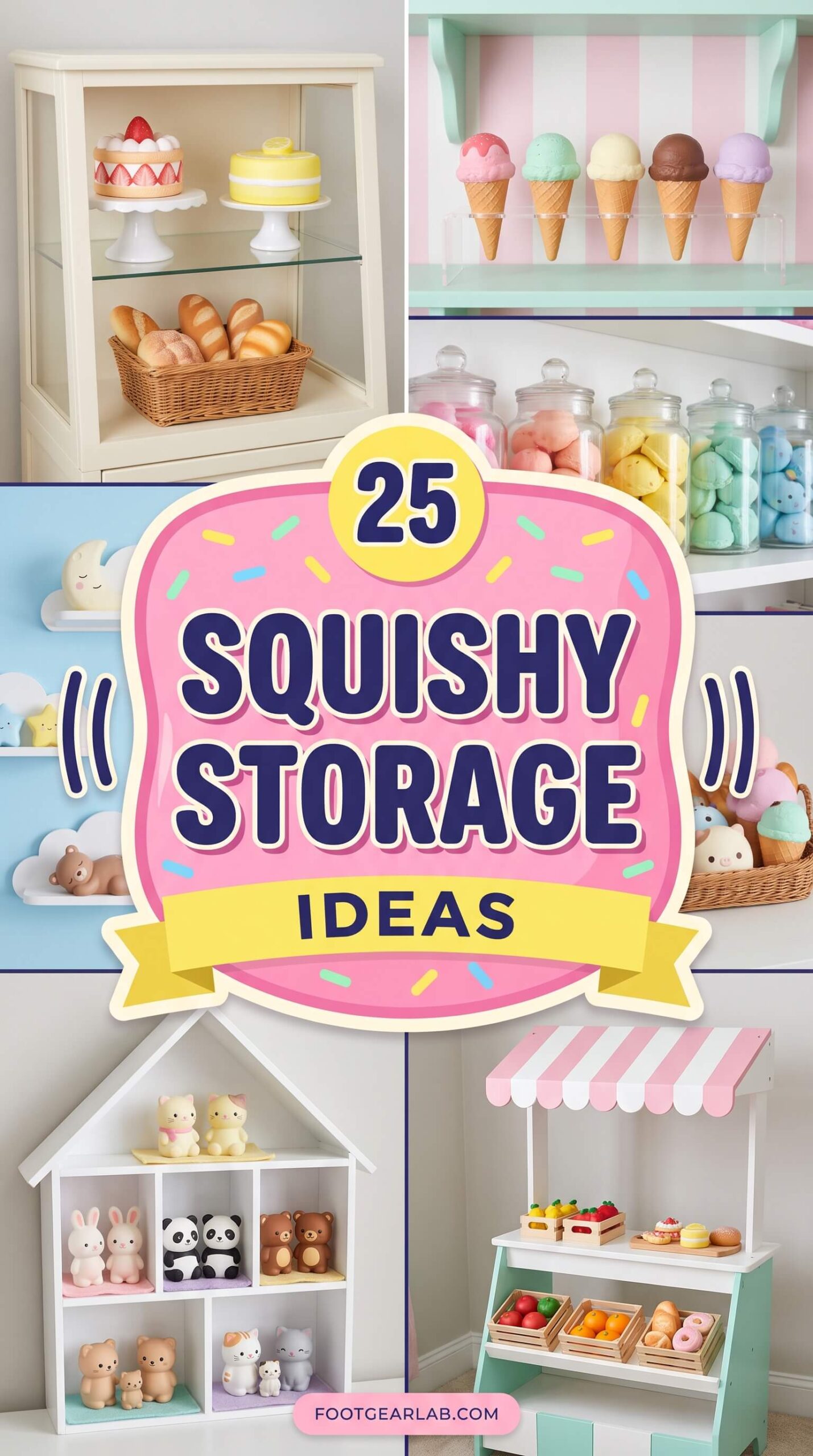
Squishies multiply fast. First there’s one strawberry cake squishy on the nightstand. A few months later there are bread loaves in the toy box, mini donuts between the couch cushions and a slightly flattened panda at the bottom of a school bag. Maybe you’re a mom trying to tame your daughter’s growing collection, or maybe you’re a grown-up collector who loves these soft, slow-rising treasures (they really are calming to squeeze). Either way, good storage makes a big difference.
Good squishy storage does two jobs. It keeps the collection cute enough to enjoy every day, and it protects soft foam from the things that slowly ruin it: dust, lint, sunlight, heat and being crushed under heavier toys. A squishy that’s stored well stays soft, keeps its colors and rises slowly the way it should. One that’s been tossed in a deep bin can turn sticky, faded or permanently dented.
Below are 25 squishy storage ideas. Some are showpieces, like a bakery-style pastry case or a little “squishy town” bookcase. Others are practical and dust-free, like drop-front boxes and bead organizers for minis. Each idea has steps to recreate it and a note on who it suits best. Start with the quick squishy care guide so you can choose storage that keeps your collection squeezable for years.
Before You Start: Know Your Squishies
Not every squishy needs the same kind of home. Most squishies are made from slow-rising polyurethane foam, the soft, spongy kind that sinks when you squeeze it and slowly puffs back up. Foam squishies are light and easy to store, but they’re also porous, so they pick up dust, lint and pet hair, and they fade or yellow over time in sunlight. Mochi squishies are different. These small, stretchy, slightly see-through squishies are made from a soft rubbery material, and they feel tacky to the touch, so they grab every crumb and hair nearby unless they have their own clean compartment.
Size matters too. Mini squishies and squishy charms can disappear into a big bin, while jumbo squishies need room so they aren’t pressed out of shape. Use the table below to match each part of your collection to the right type of storage.
| Squishy Type | Typical Size | What It Needs | Best Storage Types |
|---|---|---|---|
| Mini foam squishies and charms | 1 to 2 in (2.5 to 5 cm) | Small compartments so they don’t get lost; keep away from toddlers and pets | Bead organizers, printer’s trays, jewelry boxes, cantilever boxes |
| Regular foam squishies | 3 to 5 in (7.5 to 13 cm) | Space so they aren’t squashed, protection from dust | Cubbies, spice rack ledges, drop-front boxes, glass cabinets |
| Jumbo foam squishies | 6 to 10 in (15 to 25 cm) and up | Plenty of room; never stacked under other toys | Wide shelves, storage benches, under-bed drawers, cloches |
| Mochi squishies | About 1 to 2.5 in (2.5 to 6 cm) | Their own clean, lidded compartment, as they attract lint | Bead organizers, lidded jars, small clear boxes |
| Collectible or limited editions | Any size | Full dust protection and little handling | Glass cabinets, cloches, drop-front boxes |
The Five Things That Damage Squishies
- Sunlight: UV light fades the painted colors and slowly yellows foam, especially white and pale pastel squishies. A sunny windowsill is the worst spot for a collection, and glass doors in direct sun can make it worse.
- Heat: Warm spots, like shelves above a radiator or a hot car, can make foam and paint turn tacky. Keep the collection in a cool, room-temperature part of the house.
- Dust and lint: Foam is full of tiny pores that trap dust, and mochi squishies are naturally sticky. Lids, doors and closed boxes cut cleaning time a lot.
- Pressure: Slow-rising foam recovers from a squeeze, but weeks of being pressed under heavier toys can leave dents and creases. Store squishies in a single layer, or loosely, and never under books or hard toys.
- Little hands and paws: Minis, charms and torn-off foam pieces are a choking hazard for babies, toddlers and pets that chew. Keep small squishies up high or in closed containers if you have little ones or a curious dog at home.
A Simple Sorting System
Before you buy any storage, empty the whole collection onto a clean bed or table and sort it. That one step often shows you need less storage than you thought, and it tells you which ideas below fit your collection best.
- Sort by “squeeze” or “display”: Daily favorites should live somewhere easy to reach, like a cart, a pegboard or hanging baskets. Display-only and collectible squishies go behind glass or in closed boxes where they stay clean.
- Sort by theme: Most collections fall into a few natural groups, such as bakery and sweets, fruit, animals, and characters. Theme-based storage looks charming and makes it easy for kids to put things back where they belong.
- Sort by color for display: Rainbow order is the simplest way to make a big collection look styled instead of cluttered, especially on open shelves, in jars and in cubbies.
- Set aside repairs: Put cracked, sticky or very dusty squishies in a separate box to clean or fix before they join the others, so dust and stickiness don’t spread.
Showcase Ideas That Look Like Decor
1. Bakery Pastry Case Display Cabinet
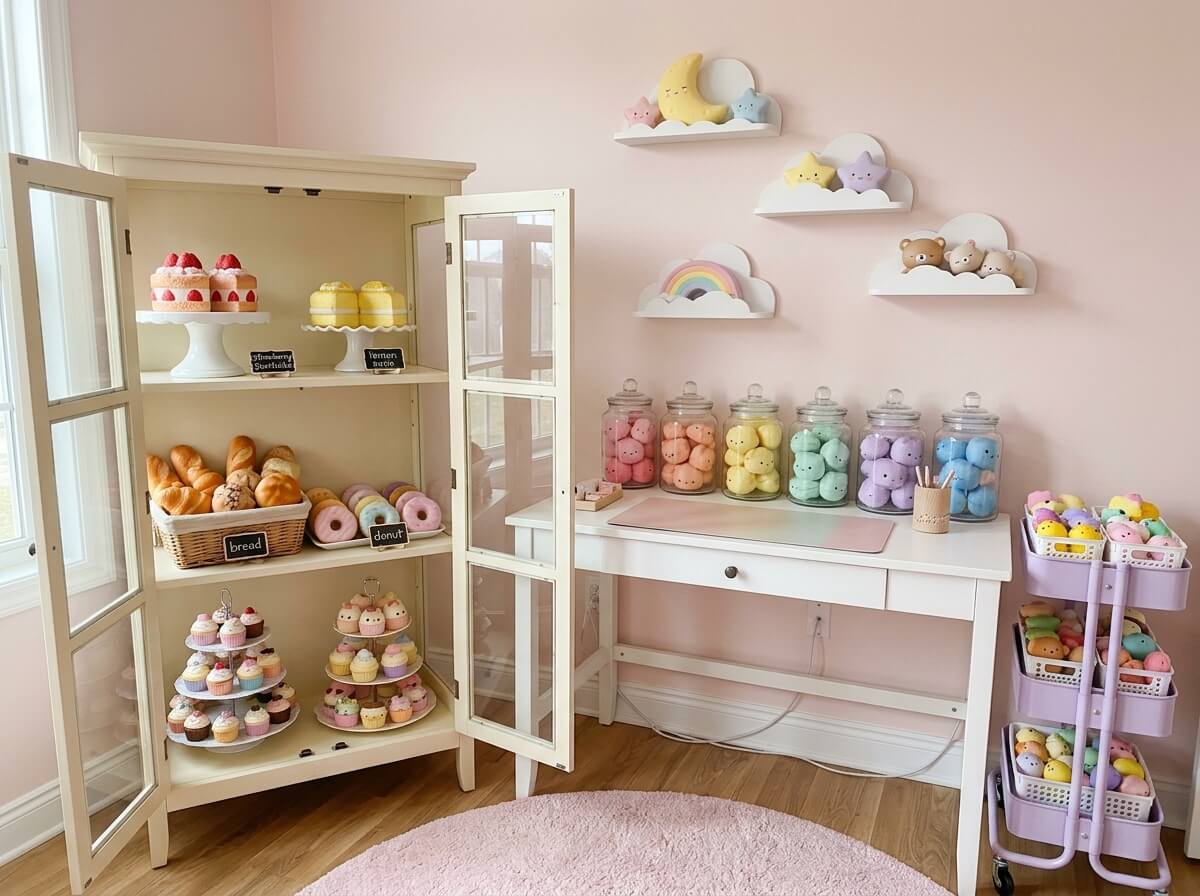
Food squishies like strawberry shortcakes, croissants, melon buns and toast slices look like they belong in a bakery, so give them one. A glass-front display cabinet, either a curio cabinet or a simple cabinet with glass doors, styled with cake stands of different heights becomes a sweet little patisserie. The glass doors keep dust off, which is what foam squishies need most, and the cabinet looks like a decor piece rather than toy storage.
Arrange the shelves like a real pastry counter. Put cakes and tarts on the stands, breads in a small wicker basket, a neat row of donuts on a long serving plate and minis on a tiered cupcake stand. A scalloped paper liner or a strip of gingham ribbon along each shelf edge finishes the bakery look. Place the cabinet away from sunny windows, since glass in direct sun speeds up fading and yellowing.
How to get the look:
- Choose a glass-front cabinet with adjustable shelves at least 10 in (25 cm) deep, so the cake stands fit without pressing squishies against the glass. Second-hand curio cabinets are often cheap and easy to paint cream, blush or mint.
- Collect three to five cake stands in different heights, plus a small bread basket and a long serving plate. Mismatched white thrift-store pieces look lovely together and cost very little.
- Group squishies by “menu”: cakes on the top shelf, breads in the middle and donuts and sweets lower down. Leave a little space around each one so the foam is never squashed against its neighbors.
Best for: Food squishy collectors, teens and adults who want a display that works as room decor, and anyone with prized pieces that need dust-free protection.
2. Wooden Cubby Wall
Sneaker collectors have shoe walls, so squishy collectors can have a cubby wall. A wall-mounted wooden grid shelf, sometimes sold as a pigeonhole shelf or a display cubby organizer, gives every squishy its own little square. Nothing presses against anything else, each squishy is easy to see, and it’s obvious right away when a favorite has gone missing under the bed.
The cubby wall looks best with a bit of color. Paint the back panel of each column a different pastel, going from pink through peach, butter yellow, mint and sky blue, then place squishies in matching colors. Open cubbies do collect dust, so dust them once a week with a soft, clean makeup brush, or choose a version with a clear acrylic front for collectible pieces.
How to get the look:
- Pick a grid shelf with cubbies at least 4.5 to 5 in (11 to 13 cm) square for regular squishies. Measure your biggest regular squishy before buying, since some animal squishies are wider than they look.
- Mount the shelf securely into studs or with heavy-duty wall anchors at a height your child can reach, or higher if it’s display-only. A grid shelf full of items is heavier than it looks.
- Paint or line the back of each column with pastel paper before you hang it, then fill the cubbies in rainbow order, one squishy per square.
Best for: Medium collections of 20 to 50 regular squishies, kids who love seeing every piece, and anyone who wants their collection to feel like a gallery.
3. Vintage Printer’s Tray for Minis
Old letterpress type drawers, also called printer’s trays, are full of tiny compartments in different sizes, and they’re perfect for mini squishies and squishy charms. Hung on the wall like a shadow box, a printer’s tray turns dozens of tiny squishies into a curated little display instead of a scattered mess. Minis are the hardest part of any collection to keep track of, and this gives each one an exact spot.
You can find original printer’s trays at flea markets and online vintage shops, or buy new reproductions sold as curio or knick-knack display shelves. Clean an old tray well with a dry brush, then wipe it with a lightly damp cloth and let it dry completely. For a dust-free version, have a clear acrylic sheet cut to size and attached over the front with small hinges or turn buttons. Because minis are a choking hazard, hang the tray up high if there’s a toddler in the house.
How to get the look:
- Measure your minis first. Most printer’s tray compartments are 1 to 2 in (2.5 to 5 cm) wide, which is just right for minis and charms but too small for regular squishies.
- Hang the tray horizontally with two sturdy picture hangers or D-rings so it sits flat against the wall and doesn’t tip forward.
- Fill the compartments by theme or color, one or two minis each. Leave a few empty for new arrivals so you never have to cram.
Best for: Mini squishy and charm collectors, adults who like vintage decor, and small bedrooms where floor space is limited.
4. House-Shaped Bookcase “Squishy Town”
A house-shaped bookcase, the kind with a pointed roof and a few square “rooms,” gives animal squishies their own little home. Kids love it because the storage becomes a play scene. The bunny lives upstairs, the panda family lives next door, and putting toys away turns into putting everyone “to bed.” It’s one of the easiest ways to get little ones to tidy up without a fight.
For a whole “squishy town,” line up two or three small house shelves of different heights along a wall. Give each room a small square of pastel felt as a rug, which keeps squishies off bare wood and looks cozy. If you want to add battery LED fairy lights along the roofline, LEDs stay cool and won’t warm the foam, but keep any battery packs out of small children’s reach.
How to get the look:
- Choose a house-shaped bookcase with compartments at least 8 in (20 cm) wide so a small squishy “family” of two or three fits in each room without being pressed together.
- Anchor the bookcase to the wall with an anti-tip strap, especially if young children will be reaching into it.
- Cut felt squares to fit each compartment floor, then group animal squishies into families, one family per room, with the tiniest ones in the attic.
Best for: Animal squishy collections, kids aged 4 and up, playrooms, and parents who want storage that encourages tidying.
5. Glass Cloches for Rare Favorites
Every collection has a few squishies that are more special than the rest: a first squishy, a limited edition, a gift from a best friend. Give those under-glass treatment with bell jar cloches on wooden bases. A cloche keeps dust and fingers off completely and makes even one small squishy look like a treasure in a little museum.
Group three cloches of different heights on a tray on a dresser or bookshelf so they look like a styled vignette. Keep them out of direct sunlight, since a glass dome in the sun gets warm inside. Swap the squishies under the cloches every season to show off different favorites while the rest rest in their regular storage.
How to get the look:
- Choose cloches with a little room around the squishy. A dome that touches the sides or top of the squishy will press it out of shape over time.
- Pick bases in natural wood or white marble-look so the squishies’ colors stand out, and set the group on a round or oval tray.
- Lift each dome once a month to check the squishy and wipe the inside of the glass with a soft dry cloth.
Best for: Collectors with limited editions or sentimental pieces, adults who want an elegant display, and shared spaces where little siblings like to grab.
6. Ice Cream Parlor Cone Stand
Ice cream cone and scoop squishies are some of the cutest in any collection, and they look even better displayed like a real ice cream counter. Clear acrylic ice cream cone holders, the kind sold for parties, hold cone squishies upright so their “scoops” don’t get crushed. Glass sundae cups work for round scoop squishies, and a jar of striped paper straws finishes the parlor look.
Set it all up on a single painted shelf or the top of a low bookcase. A shelf painted mint or pink with a striped wall or backdrop behind it looks straight out of a vintage ice cream shop. Never stack scoop squishies on top of each other inside the cups. One or two per cup keeps their shape round and fluffy.
How to get the look:
- Buy a clear acrylic cone holder with four to six holes. Check that the holes are wide enough for your cones to sit in without being forced.
- Add two or three glass sundae cups or small footed dessert bowls for scoop squishies, plus a jar of paper straws as decoration.
- Place the display on a shelf away from windows, and dust it weekly with a soft brush, since open displays collect dust.
Best for: Sweet-treat collectors, kids who love playing “shop,” and anyone who wants a themed display that doubles as wall decor.
Wall and Shelf Storage
7. Spice Rack Ledges
Narrow wooden spice racks with a front rail are a clever, cheap way to store regular squishies in neat single rows. The rail keeps them from rolling off, and the shallow depth means every squishy sits at the front where you can see it. Stack four or five racks in a column on a bedroom wall, beside a desk or even on the inside of a closet door, and you’ll have a squishy wall that takes up almost no room.
Paint the racks white or one soft pastel so the squishies stand out, and give each row a color. A row of pinks, a row of peaches and yellows, a row of greens and a row of blues looks bright and organized. Because the racks are shallow, they also stop the collection from turning into a pile, since each row only holds what fits.
How to get the look:
- Look for wooden spice racks about 2.5 to 3.5 in (6 to 9 cm) deep with a front rail. Plain unfinished ones are easy to paint any color.
- Mount them in a vertical column about 6 to 7 in (15 to 18 cm) apart so taller squishies have head room.
- Fill one row per color and stand the squishies upright, side by side, with a little space between each.
Best for: Small bedrooms, the back of closet doors, renters (use one rack and light-duty anchors), and collections of regular-size squishies.
8. Cloud Floating Shelves
Cloud-shaped floating shelves above a bed or desk make a dreamy home for squishies, especially stars, moons, rainbows, sheep and sleepy animals. They turn a plain wall into a soft, whimsical feature and keep the display squishies off the bed, where they’d otherwise end up squashed under pillows.
Choose cloud shelves with a small raised lip or a flat top that’s at least 4 in (10 cm) deep, since some decorative cloud shelves are too shallow to hold anything. Place display-only squishies on the higher shelves and daily favorites within easy reach. Don’t hang them directly above a radiator, and keep them out of the strip of sunlight from a window.
How to get the look:
- Buy or DIY three cloud shelves in two sizes. White, pale blue or soft pink look the most dreamy against a pastel wall.
- Hang them staggered rather than in a straight line, like clouds drifting across the sky, and secure them with proper wall anchors.
- Theme each cloud, for example a “night sky” cloud with moons and stars, a “rainbow” cloud and a “sleepy animals” cloud.
Best for: Kids’ and teens’ bedrooms, nurseries for older siblings (high and out of reach), and anyone who loves a soft, whimsical look.
9. Pegboard Squishy Station
A painted pegboard is the most flexible squishy storage there is. Small peg shelves hold regular squishies, clip-on wire baskets hold handfuls of daily favorites, little cups catch minis, and hooks hold squishy keychains on their ball chains. Since every piece moves, the setup can change as the collection grows or as your child’s favorite theme shifts from bakery to animals to fruit.
Paint the pegboard a soft color, like blush, mint or butter yellow, and mount it above a desk or play table. Line wire baskets with a small piece of felt or cotton fabric so the wire doesn’t press marks into soft foam. A pegboard is also perfect for keeping a little squishy care kit (a soft brush and cornstarch shaker) right next to the collection.
How to get the look:
- Choose a pegboard about 24 by 36 in (60 by 90 cm) and mount it with spacers so the hooks have room behind the board.
- Mix accessories: two small shelves, three baskets, a couple of cups and a row of hooks for keychain squishies.
- Keep the busiest, most-used items at your child’s eye level and the display pieces at the top.
Best for: Growing collections that change often, kids who like to rearrange, craft rooms, and keychain squishy collections.
10. Hanging Three-Tier Baskets
A hanging tiered basket, the kind usually used for fruit in the kitchen, works perfectly for a pile of daily squeeze favorites. It keeps squishies off the floor and the bed, uses an empty corner, and is easy for kids to reach when they want something to squeeze while reading or doing homework.
Choose woven or wire baskets, and if you go with wire, line each tier with a round of felt or a cotton napkin so the wires don’t leave marks on soft foam. Don’t fill the tiers to overflowing, as the squishies at the bottom will get squashed. Five or six per tier is plenty. Hang it in a corner away from direct sunlight; a spot beside a window with sheer curtains works well.
How to get the look:
- Install a sturdy ceiling hook into a joist, or use a wall-mounted plant bracket, then hang the basket so the bottom tier is within your child’s reach.
- Line each tier with felt or fabric and assign a theme to each, such as sweets on top, fruit in the middle and animals at the bottom.
- Keep minis out of the basket and in a lidded container instead, since they slip through gaps and are easy to lose.
Best for: Daily squeeze favorites, reading nooks, renters (a wall bracket instead of a ceiling hook), and small rooms with an empty corner.
11. Over-the-Door Clear Pocket Organizer
An over-the-door shoe organizer with clear pockets turns the back of a bedroom or closet door into storage for an entire collection. Each pocket holds one or two squishies, everything is visible at a glance, and it takes up zero floor space. It needs no drilling either, which makes it a favorite with renters.
Assign each pocket a theme or color, working in rainbow order from top to bottom, so the door looks pretty instead of messy. Don’t jam regular squishies into narrow pockets, since that presses them out of shape. Choose an organizer with wide pockets, and keep sticky mochi squishies in their own lidded containers instead, as they can stick to the pocket material and pick up lint.
How to get the look:
- Choose an organizer with clear pockets at least 4.5 in (11 cm) wide and sturdy metal door hooks. Check that the door still closes over the hooks.
- Sort squishies by color, then fill the pockets one or two at a time, starting with pinks at the top and blues at the bottom.
- Use the lowest pockets for your child’s daily favorites so they can reach them, and the top pockets for display pieces.
Best for: Renters, small bedrooms, shared kids’ rooms, and big collections of regular-size foam squishies.
Closed and Dust-Free Storage
12. Drop-Front Clear Stacking Boxes
Clear sneaker boxes with drop-down front doors are a favorite among serious collectors, and they work just as well for squishies. Each box holds one category, the clear sides show what’s inside, and the front door opens without unstacking the whole tower. Squishies stay dust-free, and the boxes stack into a neat wall on a dresser or shelf.
Sort one theme per box, for example bakery, fruit, animals, characters, minis and jumbos, and tie a small blank tag to each handle to write the category on. Many of these boxes have small air holes, which is good for scented squishies and helps prevent stuffy smells. Stack them no more than four or five high on a flat, sturdy surface so the tower stays stable.
How to get the look:
- Buy a set of drop-front boxes in standard and large sizes; the large ones fit jumbo squishies without squashing them.
- Stack the boxes on a low dresser or open bookcase, four across and three high, with heavier categories at the bottom.
- Fill each box loosely in a single layer or two at most, and add a tag so everyone knows where things go.
Best for: Large collections, collectors who want dust-free storage they can still see, and families who want everything in one tidy spot.
13. Candy Shop Apothecary Jars
Lidded glass apothecary jars sorted by color look just like the jars in an old-fashioned candy shop, and they’re one of the prettiest ways to store a collection. The lids keep dust and lint out, the glass shows off every squishy, and a row of rainbow jars on a shelf reads as decor rather than clutter.
Choose wide-mouth jars so squishies slide in without being squeezed through a narrow neck, and fill them only about two-thirds full so nothing at the bottom gets crushed. Never put a damp squishy in a closed jar, since trapped moisture can cause smells, and lift the lids now and then to let scented squishies breathe. Glass is heavy and breakable, so place the jars on a sturdy shelf out of reach of toddlers.
How to get the look:
- Collect six wide-mouth jars with lids in two heights. Matching jars look polished, while mixed vintage shapes look playful.
- Sort the collection into color groups: pink, peach, yellow, mint, lilac and blue.
- Arrange the jars on an open shelf in rainbow order, alternating tall and short for a candy shop rhythm.
Best for: Small and medium squishies, minis, mochi squishies (in their own jar), and anyone who wants storage that doubles as decor.
14. Adjustable Bead Organizer for Minis
Craft bead organizers, the clear-lidded boxes with adjustable dividers, are made for small things, and mini squishies fit them perfectly. Every compartment closes under the lid, so minis stay dust-free and can’t roll away, and the whole box carries easily to a friend’s house for trading or to the couch for play.
Pick a box with removable dividers so you can make some compartments bigger for slightly larger minis. Give each compartment a theme, like tiny cakes, fruit, animals and charms. If your child collects mochi squishies, give them their own compartments, and lightly dust sticky ones with cornstarch so they don’t cling to the lid.
How to get the look:
- Choose a bead or craft organizer with a hinged clear lid, secure latches and removable dividers, about 11 by 7 in (28 by 18 cm).
- Set the dividers to fit your minis, keeping two or three empty compartments for new arrivals.
- Store the box upright on a bookshelf like a book, or flat in a drawer, and keep it out of reach of toddlers.
Best for: Mini squishies, mochi squishies, squishy charms, trading on the go, and small bedrooms.
15. Jewelry Box with Drawers
A jewelry box with small drawers is a lovely, grown-up home for minis and squishy charms. The drawers keep dust out, the compartments stop minis from tumbling together, and a pretty box on a vanity or dresser looks like it holds treasures, which in a collector’s eyes it does.
Look for boxes with several shallow drawers and removable compartment trays. Velvet-lined boxes look beautiful with foam minis, but sticky mochi squishies can pick up the velvet fibers, so line their drawer with a smooth piece of parchment or keep them elsewhere. Thrift stores and vintage markets often have old jewelry boxes that only need a fresh coat of paint.
How to get the look:
- Choose a jewelry box with at least three or four drawers no less than 1.5 in (4 cm) deep, so minis aren’t pressed by the drawer above.
- Paint a vintage box blush, sage or cream and swap the knobs for pretty ceramic ones.
- Give each drawer a theme, and keep favorite charms on the top tray where they’re easy to admire.
Best for: Minis and charms, teen and adult collectors, vanity and dresser tops, and anyone who loves vintage pieces.
16. Bento Drawer Dividers
If you prefer squishies out of sight, turn a dresser drawer into a “squishy bento box.” Bamboo or acrylic drawer organizer trays in different sizes fit together inside the drawer like the compartments of a bento lunch, with breads in a long tray, donuts in a square one, minis in tiny trays and animals in the bigger sections. When the drawer is closed, the room looks perfectly tidy. When it’s open, everything is sorted and easy to find.
Measure the drawer first, then plan the layout on paper so the trays fit snugly without gaps that let squishies slide around. Keep everything in a single layer, since drawers that are stacked full press the bottom squishies. A shallow drawer of about 3 to 5 in (8 to 13 cm) deep is ideal.
How to get the look:
- Measure the inside width, depth and height of the drawer, then choose interlocking bamboo or acrylic trays in three or four sizes.
- Lay the trays out like a puzzle, with long trays along the back and small ones in front for minis.
- Assign one theme per tray and keep a single layer only, so the drawer closes without pressing on any squishy.
Best for: Minimalist rooms, parents who want toys out of sight, shared bedrooms, and collectors with a spare dresser drawer.
17. Vintage Bread Box for Bread Squishies
Bread squishies are some of the most popular squishies there are, so why not keep them in an actual bread box? A roll-top wooden or pastel enamel bread box closes to keep dust out, and the theme is so charming that it can sit right out on a shelf or in a play kitchen. Kids love “baking” and putting their loaves away at the end of the day.
Bread boxes often have small air holes in the back or sides, which is great for scented squishies. Line the inside with a clean linen tea towel so the squishies sit softly. Many bread boxes have “BREAD” printed on the front; a plain one, or one you’ve painted, looks more like decor.
How to get the look:
- Find a bread box at least 12 in (30 cm) wide; vintage enamel bins and wooden roll-tops are easy to find second-hand.
- Line it with a linen or cotton tea towel, then fill it with bread and bakery squishies in a loose layer.
- Place it on a low shelf or a play kitchen counter so it’s part of playtime as well as storage.
Best for: Bread and bakery squishy collections, play kitchens, kids who love pretend play, and themed bedroom or playroom shelves.
Mobile Storage You Can Move Around
18. Rolling Pastel Utility Cart
A three-tier rolling cart goes wherever the squishies go: beside the couch for movie night, next to the desk during homework and back into the corner when it’s time to tidy up. It’s an easy way to keep daily favorites handy without letting them spread over every surface in the house.
Use the top tier for favorites in small baskets, the middle tier for clear lidded bins of themed squishies, and the bottom tier for a care kit and backup storage. A pastel metal cart in lilac, mint or blush looks great in a bedroom, and the open tiers make it easy for kids to put things back on their own.
How to get the look:
- Choose a three-tier metal cart with locking wheels so it stays put on carpet or near stairs.
- Add small baskets or clear bins on each tier, so squishies don’t roll off when the cart moves.
- Keep a care kit on the bottom: a soft makeup brush, a small shaker of cornstarch and a clean microfiber cloth.
Best for: Daily-play collections, families who move between rooms, small apartments, and kids who are learning to tidy up.
19. Turntable Tower
A two-tier turntable, the lazy Susan type used in kitchen cabinets, turns a small patch of bookshelf or desk into a rotating squishy display. Give it a spin and every squishy comes to the front, so nothing gets forgotten in the back. It takes up only about 10 to 12 in (25 to 30 cm) of space and holds far more than a flat shelf would.
Choose a turntable with a raised edge on each tier so squishies don’t slide off when it spins. Arrange them in rings by color or theme: bigger squishies on the bottom tier and smaller ones on top. Kids find spinning it to choose a squishy just as fun as the squishies themselves.
How to get the look:
- Pick a two-tier turntable with a raised lip, at least 10 in (25 cm) across. White, clear acrylic and bamboo all work well.
- Place it on a bookshelf, desk corner or nightstand where it can spin freely without knocking anything.
- Arrange regular squishies in a ring on the bottom tier and smaller ones on the top tier, leaving a little space between each.
Best for: Desks and nightstands, small collections of 15 to 25 squishies, small spaces, and kids who like a little fun with their tidying.
20. Cantilever Craft Box
A cantilever box, the kind with trays that fan out up and outward when you open the lid, is like a treasure chest for squishies. Vintage wooden sewing boxes and modern craft cantilever boxes both work, and the moment the trays open to show rows of tiny compartments is pure joy for kids and collectors alike.
These boxes have a carry handle, so the whole collection can travel to a grandparent’s house or a play date and close back up neatly. Use the small upper trays for minis and charms and the deeper bottom section for regular squishies. A pastel painted wooden box looks lovely sitting closed on a shelf, too.
How to get the look:
- Find a cantilever box with at least two levels of trays; thrift stores often have wooden sewing boxes that just need sanding and paint.
- Paint the outside a soft color, like butter yellow, mint or blush, and line the trays with felt if the wood is rough.
- Sort minis into the trays by theme, and keep regular squishies in the deep base so nothing is pressed when the box closes.
Best for: Mini and small squishies, play dates and travel, vintage lovers, and collections that need to close up neatly.
21. Under-Bed Rolling Drawer
The space under the bed is perfect for the part of the collection that isn’t on display: backups, seasonal favorites, jumbo squishies and collectible packaging. A shallow rolling drawer with dividers slides out easily, keeps everything in one layer and stays hidden when it’s not in use.
Pick a drawer with a lid, or one that sits snugly under a bed frame, to keep dust out, since dust collects quickly under beds. Line it with felt or fabric sections, and never pile squishies on top of each other. If you keep original packaging for collectible squishies, store the flat bags in one section so they stay clean and uncreased.
How to get the look:
- Measure the height under the bed and choose a rolling drawer that leaves at least 1 in (2.5 cm) of clearance so it glides out easily.
- Add dividers to create five or six sections, and line each with a piece of felt.
- Store squishies in a single layer, sorted by theme, and pull the drawer out once a week to air it and check for dust.
Best for: Big collections, jumbo squishies, collectible packaging, and small bedrooms where walls are already full.
Playful and Unexpected Ideas
22. Play Market Stall “Squishy Shop”
A wooden toy market stall, the kind with a little awning and shelves, makes a magical squishy shop. It’s storage and a play area in one: fruit squishies go in small crates, bakery squishies line the counter, and kids spend hours “selling” squishies to their siblings, parents and stuffed animals. At the end of the day, everything goes back on the shelves of the shop.
Add small wooden crates or berry baskets on each shelf to keep categories separate, and a blank mini chalkboard so your child can write their own “prices.” Keep the minis out of a shop used by toddlers, and use regular-size squishies for younger shopkeepers. A market stall fits neatly in a playroom corner and is far more fun to tidy than a toy box.
How to get the look:
- Choose a wooden market stall or play kiosk with at least two shelves and a counter; fabric awnings in stripes look the most like a real shop.
- Fill small wooden crates with fruit and vegetable squishies, and line bakery squishies along the counter on little plates.
- Add a blank chalkboard sign and a small toy cash register or basket for “shopping,” so storage and play stay together.
Best for: Kids aged 3 and up (with regular-size squishies), playrooms, pretend-play lovers, and families who want to make tidying fun.
23. Vintage Suitcase Display
An old hard-shell suitcase, propped open on a luggage rack or a low shelf, makes a quirky display that closes up completely when you want to keep dust out or take the collection somewhere. Lined with fabric and filled with rows of squishies, it looks like a traveling squishy shop from a storybook.
Look for a vintage suitcase in a soft color, like powder blue, mint or cream, with a fabric-lined interior. Clean the inside well and let it air out for a day or two if it smells musty, since foam soaks up odors. Arrange squishies in a single layer of neat rows in the bottom half, and use the lid pocket for flat items like stickers or a care cloth.
How to get the look:
- Find a sturdy vintage suitcase with working latches; check that the lid stays open on its own or rests safely against a wall.
- Set it on a wooden luggage rack, a bench or a low shelf, and line the base with a pastel cotton fabric if the original lining is worn.
- Arrange squishies in rows by color, and close the lid at night or when the room is being cleaned.
Best for: Vintage and boho bedrooms, collectors who travel to meetups, and anyone who wants a display that closes in seconds.
24. Storage Bench With Bins
A storage bench at the foot of the bed or under a window wall gives a big collection a home that’s hidden and comfy at the same time. Lift the cushioned lid and there are removable fabric bins inside, one per category, and close it and the bench is a seat for putting on shoes or reading. Because the squishies sit inside bins under a solid lid, nobody sitting on top squashes them.
Use soft fabric or linen bins rather than one big open space, so squishies don’t end up in a jumble at the bottom. Choose a bench with a soft-close hinge if young children will open it, so the lid can’t drop on fingers. Avoid placing it right under a sunny window, since the lid and bins can get warm in direct sun.
How to get the look:
- Pick a storage bench with a hinged, cushioned top and a soft-close or safety hinge.
- Fit three or four removable linen or cotton bins inside, each with a theme like bakery, animals, fruit and jumbos.
- Keep the bins only loosely filled so the lid closes without touching the top squishies.
Best for: Large collections, kids’ bedrooms where floor space is free but wall space isn’t, and families who want toys hidden but easy to reach.
25. Travel Squishy Kit
For car trips, sleepovers and waiting rooms, a small travel kit keeps a few favorite squishies safe instead of crushed at the bottom of a bag. A clear hard-shell pencil case or zip box works best, because it protects the squishies from being squashed under books and water bottles. Add a tiny care kit and they’ll come home just as clean as they left.
Choose four or five favorites, not the whole collection, and pack a small shaker of cornstarch, a soft makeup brush and a folded microfiber cloth. Never leave the kit in a hot car, since heat can make foam and paint sticky. If your child wants to take squishies to school, check the school’s rules first, as some classrooms limit fidget toys.
How to get the look:
- Choose a clear hard-shell pencil case or small zip box about 8 by 4 in (20 by 10 cm) with a sturdy zipper.
- Pack four or five favorites with a little room to spare, plus a mini care kit with cornstarch, a soft brush and a cloth.
- Clip the kit to a backpack loop or keep it in a front pocket where it won’t be crushed.
Best for: Car trips, sleepovers, appointments, collectors attending meetups, and kids who never leave home without a squishy.
Comparing Squishy Storage Types
Not sure which idea fits your collection? This table compares the main types of squishy storage on the things that matter most: dust protection, how easy it is to see the collection, cost and who each suits.
| Storage Type | Dust Protection | Visibility | Budget | Best For |
|---|---|---|---|---|
| Glass-front cabinet | Excellent | Excellent | Medium to high | Prized collections, display-worthy decor |
| Glass cloches | Excellent | Excellent | Low to medium | A few rare or sentimental favorites |
| Drop-front clear boxes | Excellent | Very good | Medium | Large collections sorted by theme |
| Lidded glass jars | Very good | Very good | Low to medium | Small squishies sorted by color |
| Bead organizers and jewelry boxes | Very good | Good | Low | Minis, mochi squishies and charms |
| Bento drawers and storage benches | Very good | Low (hidden) | Low to medium | Hidden storage, tidy-looking rooms |
| Cubby wall and spice rack ledges | Low (open) | Excellent | Low to medium | Show-off displays, color sorting |
| Pegboard and hanging baskets | Low (open) | Good | Low | Daily favorites and flexible setups |
| Rolling cart and turntable | Low (open) | Good | Low | Daily play, moving between rooms |
| Over-the-door organizer | Fair | Very good | Low | Renters, small rooms |
A good rule of thumb is to mix two types: closed, dust-free storage for display and collectible pieces, and one open, easy-to-reach spot for the five to ten squishies that get squeezed every day.
How to Care for Squishies in Storage
- Dust gently and often: Once a week, brush open displays with a clean, soft makeup brush. It lifts dust out of the foam’s pores without scratching the paint, which a rough cloth or a lint roller can do.
- Clean foam squishies with care: Dab dirty spots on foam squishies with a barely damp soft cloth and a drop of mild soap, then blot dry. Avoid soaking them, since foam absorbs water and can take a long time to dry.
- Dry completely before storing: Let any cleaned squishy air-dry for at least a full day, away from heat and sun, before it goes back in a closed box or jar. Putting away a damp squishy can lead to stale smells.
- Fix stickiness with cornstarch: If foam or mochi squishies feel tacky, lightly dust them with a pinch of cornstarch and brush off the extra with a soft brush. Rinse mochi squishies in lukewarm soapy water first if they’re dirty, then pat them dry.
- Rotate your favorites: Swap displayed squishies with stored ones every few months. This spreads out light exposure and keeps the collection feeling fresh.
- Check for cracks: Look over the collection now and then. Squishies with deep cracks or loose pieces should go in the repair box, and torn foam pieces should be thrown away if there are small children or pets in the home.
- Store packaging flat: If you keep original bags or boxes for collectible squishies, store them flat in a file box or under-bed drawer so they stay crisp and clean.
Common Squishy Storage Mistakes
- Tossing everything in a deep toy bin: The squishies at the bottom get pressed under the weight of the others for weeks, which can leave dents, and they also collect crumbs and dust. Shallow storage and single layers are much kinder to foam.
- Displaying on a sunny windowsill: Sunlight is the main reason squishies fade and turn yellow. Even a few weeks in a bright window can change a pale pink squishy’s color.
- Sealing squishies in while damp: A squishy that isn’t fully dry can trap moisture in an airtight box or jar. Always let it dry completely first.
- Mixing mochi squishies with everything else: Sticky mochi squishies collect lint and can cling to foam, plush toys and fabric. Give them their own clean, lidded compartment.
- Storing heavy toys on top: Books, blocks and hard toys on top of squishies press them out of shape. Squishies should always be the top layer, or better still, in their own space.
- Leaving minis within reach of toddlers and pets: Mini squishies and charms are small enough to be a choking hazard. Keep them up high or in latched boxes if little ones or chewing pets share the home.
- Buying storage before sorting: It’s easy to buy pretty boxes that end up too small for jumbos or too big for minis. Sort and measure the collection first, then choose storage to match.
Frequently Asked Questions
How do you store squishies so they don’t get dusty?
The best way is closed storage with clear sides or glass, such as a glass-front cabinet, drop-front boxes, lidded jars or a bead organizer for minis. If you love open displays like cubbies or spice rack ledges, keep only a portion of the collection out, and brush it with a soft makeup brush once a week.
Can you store squishies in plastic bags?
Yes, many collectors keep squishies in their original bags or in resealable bags, especially limited editions. Make sure each squishy is completely dry first, don’t press the air out so hard that the squishy is squashed, and store the bags flat in a box rather than piled under heavy things.
Why do squishies get sticky, and can storage help?
Squishies can turn tacky over time from heat, humidity, age and the paint on their surface breaking down. Storing them in a cool, dry, shaded spot slows this down. For squishies that are already sticky, a light dusting of cornstarch helps, and keeping them in a closed container stops them from collecting lint in the meantime.
How do I stop my squishies from turning yellow?
Keep them out of direct sunlight, which is the biggest cause of fading and yellowing in foam. Some slight yellowing is normal over the years, especially for white squishies, but storing them away from windows and rotating your displayed favorites makes a big difference.
What’s the best storage for a really large squishy collection?
For collections of 100 or more, mix storage types. Use drop-front boxes or an under-bed drawer for the bulk of the collection sorted by theme, a display cabinet or cubby wall for favorites, and a bead organizer for minis. Sorting first and keeping one theme per container makes even a huge collection easy to manage.
Are squishies safe to store in a toddler’s room?
Regular-size squishies are generally kept as toys for older kids, and minis and charms are a choking hazard for babies and toddlers. If a toddler shares the room, store all squishies, especially minis, up high or in latched containers. Also check that the squishies you buy are age-appropriate for the youngest child in the home.
Final Thoughts
The best squishy storage protects the collection and also lets you enjoy it. Start by sorting your squishies into display pieces and daily favorites, then mix one dust-free option, like a glass cabinet, drop-front boxes or candy jars, with one easy-to-reach spot for everyday squeezing. Keep everything out of the sun, in single layers and away from heavy toys, and your squishies will stay soft, bright and slow-rising for years.
Most of all, have fun with it. Whether your collection ends up in a little bakery case, a cloud-filled wall, a squishy town or a play market stall, the right storage makes squishies part of the room’s charm rather than a pile to step around. Pick one or two ideas that fit your space this weekend, and you might find tidying up becomes the best part of playtime.