Your coffee table sits in the middle of your living room, so it’s usually the first thing people see when they walk in. It’s also one of the easiest places in the house to make a big change. A good coffee table setup makes a room look finished and relaxed without much effort. A bad one turns into a pile of remotes, mail, and half-empty mugs that makes the whole space feel messy, however nice your sofa or rug is.
Interior designers style coffee tables with a set of simple rules for height, texture, grouping, and empty space, and those rules are easy to learn. Once you know them, you can make any table look like it came out of a magazine, and you can do it with things you probably already own. This guide covers the designer formula, the steps in order, ideas for different table shapes and decor styles, seasonal swaps, budget tricks, and the mistakes that quietly ruin a nice setup.
Why Coffee Table Styling Matters More Than You Think
The coffee table ties your seating area together. It sits between the sofa and the chairs and links the rug, pillows, and wall decor in one spot. When it’s styled well, it pulls those colors and materials into the middle of the room and makes the whole space feel planned.
It also has real jobs to do. You set down a drink there, put your feet up, play board games, or rest a laptop on it. Designers don’t treat the table as a display case nobody can touch. They make it look good and still leave room for everyday use. That’s the line between a table that looks styled and one that feels livable, and it’s the balance you’re aiming for.
Before You Start: Check Your Table and Your Space
Make sure the table fits the room. Even great styling can’t fix a table that’s the wrong size. A common designer guideline is a coffee table about two-thirds the length of your sofa, with a top within an inch or two of your sofa seat height. Leave roughly 14 to 18 inches between the table and the sofa so you can reach a drink and still walk past easily. If your table is far too small or too large, the styling will always look a little off.
Think about how you actually live. Be honest about how you use the table. If you have small children, a dog with a happy tail, or you often eat dinner in front of the TV, you’ll need sturdier pieces, fewer fragile objects, and more open surface. If the table is mostly for looks in a formal sitting room, you can use more delicate decor. Styling for your real life keeps the table from going back to clutter within a week.
Look at the rest of the room. Choose two or three colors and one or two materials that already appear in the space, like the brass of a lamp base, the green in a cushion, or the wood of a sideboard. Repeating those on the coffee table makes the room feel connected and planned instead of thrown together.
The Designer Formula: Five Elements Every Styled Table Needs
Most professionally styled coffee tables use the same five building blocks. You don’t need all five every time, but this list keeps you from forgetting something.
- An anchor. This is a tray, a large book, or a low wide bowl that defines a zone and gathers smaller items. Without an anchor, small objects look scattered. With one, they look like a group.
- Height. Something tall, like a vase of branches, a candlestick, or a sculptural object, lifts the eye and keeps everything from looking flat. It’s the piece that makes the table feel styled rather than just tidy.
- Texture. Mix materials such as smooth ceramic, rough wood, woven rattan, glossy marble, soft linen, or cool metal. Contrast between textures is what makes a table interesting even when the colors are quiet.
- Something living. Fresh flowers, a potted plant, cut greenery, or even a bowl of lemons adds life and softness. Designers almost always include something organic because it keeps a setup from feeling stiff.
- Something personal. A travel souvenir, a vintage find, a favorite book, or a small piece of art makes the table feel like yours. This is what turns a good table into a memorable one.
Step-by-Step: How to Style Your Coffee Table
Step 1: Clear Everything Off and Start Fresh
Take every item off the table, including the coasters and the remote, and wipe the surface clean. Looking at the bare table lets you see its shape, material, and color properly. It also stops you from building around clutter you’ve stopped noticing. Put all your possible decor pieces on the sofa or floor nearby so you can pick from them as you go.
Step 2: Place Your Anchor Piece
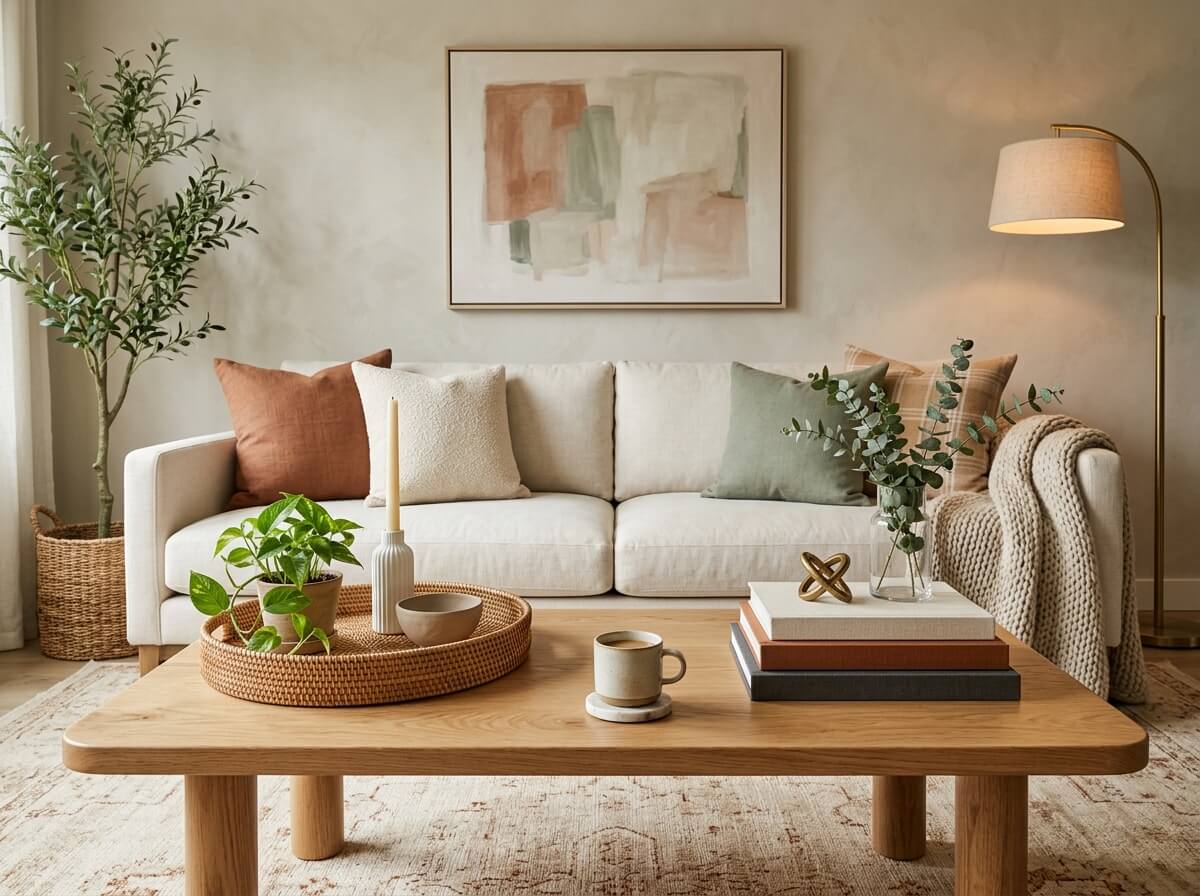
Start with a tray or other large flat piece and set it slightly off-center instead of dead in the middle. Off-center placement feels more relaxed and leaves room for a second group on the other side. On a rectangular table, a tray that covers about a third of the surface usually looks balanced. Choose a material that contrasts with the table, like a woven or wood tray on a glass table, a marble or brass tray on a wooden table, or a leather tray on stone. A tray also has a practical use, because you can lift the whole thing off when you need the table for games or snacks.
Step 3: Group Items in Odd Numbers
Designers use the rule of three, and five works too, because odd-numbered groups look natural and pull the eye around them. Even pairs tend to look stiff and formal. Inside your tray, try three objects of different heights and shapes, such as a candle, a small vase, and a little decorative box. Keep each group tight so the items look like they belong together and don’t drift across the surface.
Step 4: Create High, Medium, and Low Levels
Level variety makes a table look professional. Every group should include something tall, something mid-height, and something low. A vase of branches can be the high point, a stack of books the middle, and a small bowl or dish the low point. Keep the tallest item low enough that you can still see people across the table. Something around the height of a wine bottle, or an airy arrangement you can see through, works well. Tall, dense flowers that block faces make a seating area feel less social.
Step 5: Stack Your Books Like a Stylist
Coffee table books are one of a designer’s most useful tools. Stack two to four large hardcovers horizontally, largest on the bottom and smallest on top, and turn the spines to face the sofa or the room’s entrance. The stack works as a small pedestal, so put a small object on top, like a candle, a little sculpture, or a seashell, to lift it and make it a focal point. Pick books with covers in your room’s colors, or take off loud dust jackets to show the plain linen covers underneath. Choose topics you actually love, like travel, fashion, cooking, or art, because guests really do pick them up.
Step 6: Add Something Living
Put in your natural element. A low arrangement of fresh flowers feels romantic, a single dramatic branch in a tall vase looks modern and sculptural, and a small potted plant like a pothos or a mini olive tree is easy and long-lasting. If fresh flowers aren’t practical for you, a bowl of seasonal fruit, a moss ball, or good-quality faux stems work just as well. Greenery is especially useful in a room with lots of neutrals because it adds color that never clashes.
Step 7: Layer Contrasting Textures
Look at your table and check whether the materials are too similar. If everything is smooth and shiny, add a rough wooden bead garland, a woven basket, or a matte ceramic bowl. If everything is rustic, add a little polish with a brass candleholder, a marble coaster set, or a glossy glazed vase. The goal is a mix of at least three different textures. That contrast gives a table depth, and it’s why designer setups look rich even when every piece is beige.
Step 8: Include a Personal or Sculptural Accent
Add one piece with character. It might be a vintage brass bowl from a flea market, a ceramic piece from a trip, a small framed photo, a chess set, or an abstract sculpture with an interesting shape. This is the piece that makes someone ask, “Where did you get that?” Keep it to one or two statement items so they stand out. Too many special objects compete with each other and start to look like clutter.
Step 9: Leave Breathing Room
This step separates amateur styling from professional styling, and it’s often the hardest. Designers usually cover only about half to two-thirds of the tabletop and leave the rest bare. That empty space, called negative space, gives each group room to stand out and leaves a practical spot for a drink, a laptop, or tired feet. If your table feels crowded, take away one item at a time until it feels calm.
Step 10: Step Back and Edit
Walk to the doorway and look at the table from where guests will first see it, then sit on the sofa and look again from that angle. Check whether the heights look balanced, whether one side feels heavier than the other, and whether the colors repeat the rest of the room. Designers almost always edit at the end by swapping, shifting, and removing until everything feels easy. If you’re not sure, take a photo with your phone. Cameras make crowding and imbalance much easier to spot than your eyes do.
How to Style Different Coffee Table Shapes
| Table Shape | Best Layout Approach | Designer Tip |
|---|---|---|
| Rectangular | Divide the table into two or three zones along its length, for example a tray group on one end, a book stack in the middle, and a plant on the other end. | Keep the zones different in height so the table doesn’t look like a line of matching pieces. |
| Round | Build one central group, or a loose triangle of three small groups, and keep the edges clear so the curve shows. | A round tray echoes the shape and keeps everything looking soft and connected. |
| Square | Style in a loose diagonal, with a tall piece in one corner and lower pieces spreading toward the opposite corner. | Avoid four matching items in four corners, which looks rigid and old-fashioned. |
| Oval | Treat it like a softer rectangle with one main group off-center and one smaller supporting piece. | Curved vases and round bowls repeat the table’s shape nicely. |
| Nesting tables | Style the top table lightly and keep the lower one almost bare so it can be pulled out when needed. | One small tray with two items on the top table is often enough. |
| Ottoman | Always use a large, firm tray to create a stable flat surface on the upholstery. | Keep decor low and sturdy, since people will likely bump or sit near it. |
Coffee Table Styling Ideas by Decor Style
Modern minimalist: Keep it spare and intentional with no more than three pieces. A sleek black or white tray, one sculptural ceramic vase with a single stem, and one large art book make a striking setup. Pick clean shapes and a tight color range, and let the empty space do much of the work.
Boho: Layer warm, collected pieces such as a large rattan or seagrass tray, a stack of well-loved travel books, a trailing pothos, a beaded wooden garland, and a hand-thrown clay bowl. Earthy colors like terracotta, rust, sand, and olive suit this style. Boho welcomes a few more objects, but keep them in groups so the table still feels relaxed rather than messy.
Scandinavian: Think light wood, soft white ceramics, and cozy candles. A pale oak tray with two white candles in simple holders, a small linen-covered book, and a few eucalyptus stems in a clear glass bottle capture the calm, airy Scandinavian feel. In winter, a soft wool throw draped nearby completes the look.
Coastal: Use natural textures and soft blues, such as a whitewashed wood or woven tray, a glass hurricane holding a pillar candle, a bowl of smooth stones or a single large shell, and a stack of books with ocean-toned covers. Keep it fresh and simple, and skip themed signs and heavy nautical props, which can look kitschy quickly.
Traditional or glam: Go for polished, elegant materials like a mirrored or brass tray, crystal or gold candlesticks, a lush low flower arrangement in a porcelain bowl, and hardcover fashion or design books. Symmetry fits this style better than most, so a balanced, centered setup looks graceful rather than stiff.
Japandi: Combine Japanese simplicity with Scandinavian warmth by using dark wood or stone, a matte handmade ceramic bowl, a single gnarled branch in a minimal vase, and a small incense holder. Muted colors, natural imperfection, and plenty of empty space keep the table feeling peaceful.
Seasonal Coffee Table Swaps
You don’t need to restyle your table from scratch every season. Keep your anchor pieces, like the tray, books, and main vase, and change only the natural element and one or two accents.
| Season | What to Swap In | Mood |
|---|---|---|
| Spring | Tulips, cherry blossom branches, a bowl of lemons, pastel candles | Fresh, light, and hopeful |
| Summer | Sunflowers, a glass bowl of green apples or limes, shells, light linen textures | Breezy, bright, and relaxed |
| Autumn | Small heirloom pumpkins, dried wheat or pampas, a cinnamon or amber candle, a plaid or wool accent | Warm, cozy, and earthy |
| Winter | Pine or cedar sprigs, pinecones, a cluster of white pillar candles, a bowl of ornaments or clementines | Glowing, festive, and intimate |
These small swaps keep your living room feeling current all year without spending much money or time.
How to Get the Designer Look on a Budget
Shop your own home first. Before buying anything, walk through every room and collect possible pieces, like a pretty bowl from the kitchen, a candle from the bathroom, books from a shelf, or a small plant from the windowsill. Seen in a new spot, familiar objects often look fresh, and you may find you already have everything you need.
Thrift and flea market finds. Secondhand shops are full of brass candlesticks, marble trays, vintage bowls, and beautiful old hardcover books for a fraction of retail prices. These pieces bring character and a sense of history that’s hard to get from brand-new decor, and that collected, layered feel is something designers chase on purpose.
Use nature as free decor. Branches from your garden, a few smooth river stones, pinecones from a walk, or a bowl of fruit cost little or nothing and add the living element every styled table needs. A single interesting branch in a plain glass bottle can look as elegant as an expensive arrangement.
Spend on one quality anchor. If you buy anything new, put your money into a well-made tray or one beautiful vase, since these pieces set the tone for everything else. Inexpensive smaller items look far more expensive when they sit on a good-quality base.
Common Coffee Table Styling Mistakes to Avoid
Overcrowding the surface. The most common mistake is filling every inch of the table. With no empty space, nothing stands out and the table loses its practical use. Clear at least a third of the surface and you’ll see the difference right away.
Everything at the same height. When every item is roughly the same height, the setup looks flat and forgettable. Make sure each group has a clear high, medium, and low point to create movement and interest.
Pieces that are too small. Lots of tiny trinkets look cluttered, and from across the room they read as mess rather than decor. Designers choose fewer, larger pieces that hold their own, then add one or two small accents for detail.
Ignoring function. A table so packed with fragile decor that nobody can set down a cup is frustrating to live with. Always leave a clear landing spot, and keep remotes and coasters in a lidded box or small basket so they’re handy but hidden.
Matching everything too perfectly. Buying a full matching set of coordinated decor often looks like a showroom rather than a home. Mix old and new, shiny and matte, store-bought and found, so the table feels personal and collected over time.
Styling a Coffee Table for Kids and Pets
A beautiful table and a busy household can live together with a few smart changes. Choose unbreakable materials like wood, metal, rattan, and thick ceramic instead of thin glass and delicate porcelain. Set lit candles aside and use flameless LED candles, which look surprisingly real. Keep decor grouped on a sturdy tray so you can lift everything away in one quick move when toddlers are playing or the dog gets excited.
Pick pet-safe plants if you have cats or dogs, because some common houseplants can be toxic to animals. Check any plant against a trusted pet-safety source such as the ASPCA’s plant list before bringing it home. Keeping styling simple and sturdy means you’ll feel relaxed in your space rather than constantly guarding your decor.
Quick Designer Checklist
Before you call your coffee table finished, run through this list:
- Anchor in place: a tray, book stack, or large bowl gathers smaller items into tidy groups instead of letting them scatter.
- Three levels of height: each group includes a tall, medium, and low element so the eye moves naturally across the table.
- Odd-numbered groups: items sit in threes or fives, which look more natural and relaxed than stiff pairs.
- At least three textures: smooth, rough, and shiny materials work together to give the setup depth and richness.
- Something living: fresh flowers, greenery, a plant, or fruit softens the arrangement and brings in life.
- A personal touch: at least one piece reflects your travels, taste, or story and makes the table feel like yours.
- Empty space: roughly a third or more of the surface stays clear for breathing room and everyday use.
- Colors that repeat the room: two or three shades from your pillows, rug, or art appear on the table to tie the space together.
Final Thoughts
Styling a coffee table like a designer has less to do with expensive decor and more to do with how you arrange what you have. Start with an anchor, build groups in odd numbers, mix heights and textures, add something living and something personal, and then show some restraint by leaving open space. Those few principles are what make professionally styled rooms feel calm, collected, and inviting.
Above all, have fun with it. Your coffee table is one of the easiest and cheapest places to experiment, so change things often, try a new seasonal accent, and keep adjusting until it feels right. A well-styled coffee table makes your whole living room feel more like home.