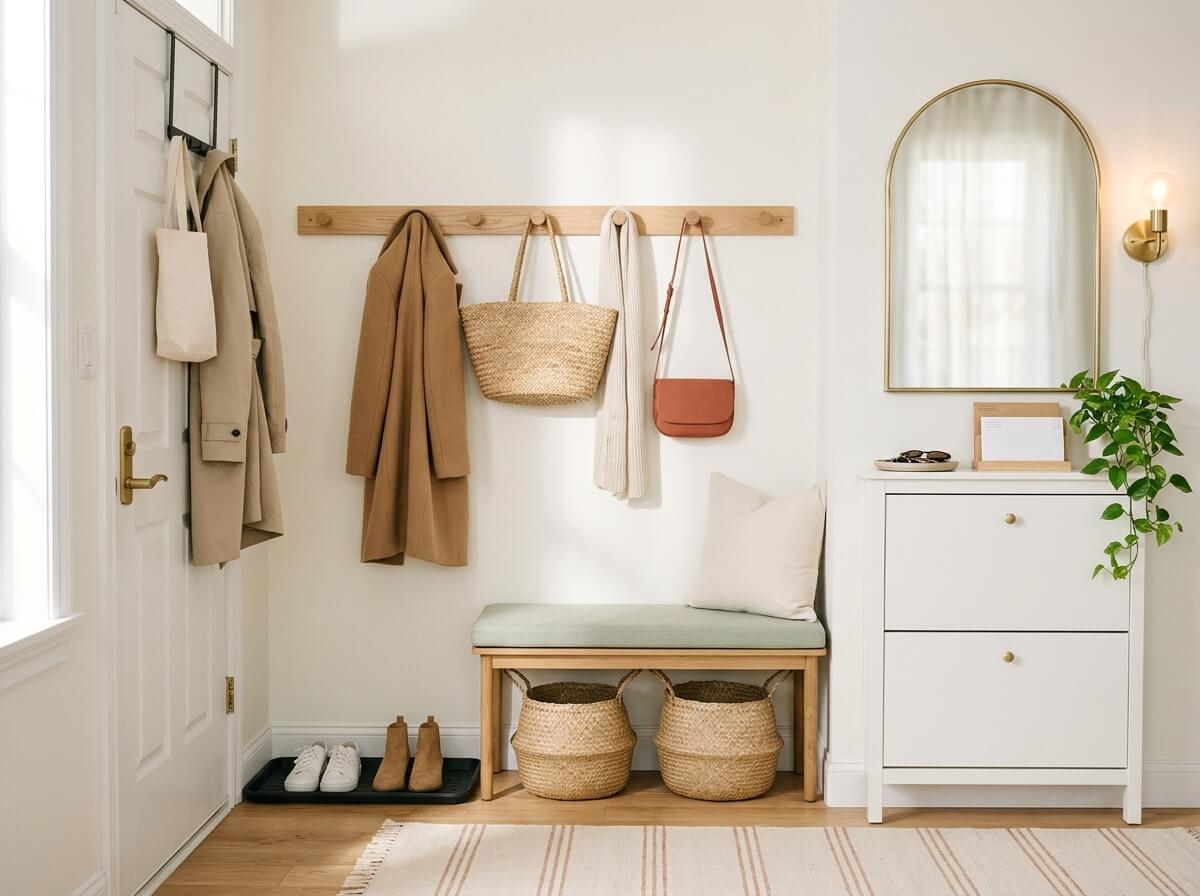
The entryway is the first thing you see when you come home and the last thing you see before you leave, yet in most small homes it is also the messiest corner of the house. Shoes pile up by the door, coats end up draped over the nearest chair, keys vanish at the exact moment you are running late, and the mail slowly turns into a small paper mountain on whatever flat surface is closest. If your “entryway” is really just a strip of wall beside the front door, or a hallway so narrow that two people can’t pass each other, it can feel like there is simply no room to get organized.
The good news is that a small entryway doesn’t need more space to work well. It needs a plan. Once every item that comes through your door has a clear home, a tiny entry can feel calm, welcoming and surprisingly functional. In this guide you’ll learn why small entryways get cluttered so fast, how to decide what really belongs there, the measurements that keep a narrow space comfortable, and fifteen smart organization ideas that work in apartments, rentals, townhouses and homes with no real entryway at all. You’ll also find shoe storage tips, a budget guide, a simple daily reset routine and the most common mistakes to avoid.
Why Small Entryways Get Cluttered So Quickly
Before buying a single basket, it helps to understand why this area gets messy in the first place. The entryway is a “transition zone,” the place where you switch from outside life to inside life. Everything you carry, wear or receive passes through it, often when you are tired, busy or in a hurry. When there isn’t an obvious spot for each item, things land wherever there is space, and a small pile quickly invites a bigger one.
Small entryways add a few extra challenges. Many apartments have no coat closet at all, so jackets and bags have nowhere to go. The space is often shared by everyone in the home, which means several people’s shoes, backpacks and umbrellas compete for the same few square feet. Seasons make things worse, because winter coats, boots and scarves take up far more room than summer sandals. And because the area is so visible, even a little clutter makes the whole home feel disorganized the moment you open the door.
The solution is not to cram in more storage. It’s to store fewer things at the door, store them vertically, and make putting things away so easy that it takes less effort than dropping them on the floor.
Step 1: Declutter and Decide What Really Belongs There
The most effective small-entryway tip costs nothing: keep only the things you use daily or weekly by the door. Everything else should live somewhere else in your home. Start by emptying the area completely, including the floor, hooks, shelves and the inside of any cabinet. Put every item into one of three groups: things you use every day (keys, your everyday bag, the shoes and jacket you wear most), things you use occasionally (rain boots, a second coat, the dog’s raincoat), and things that don’t belong there at all (old mail, gym bags you never take, shoes that no longer fit).
Only the first group earns a permanent spot in a small entryway. The second group can be stored nearby, such as in a bedroom closet or a bin under the bed, and rotated in when the weather or your plans call for it. The third group should be put away, donated, recycled or thrown out. This one step often frees up half of the space before you do anything else.
| Item | Keep at the Door? | Where It Goes Instead |
|---|---|---|
| Keys, wallet, sunglasses | Yes | Wall hook, small tray or key cabinet |
| Everyday shoes (1–2 pairs per person) | Yes | Slim shoe cabinet, tray or rack |
| Current-season coat (1 per person) | Yes | Wall hook or peg rail |
| Everyday bag or backpack | Yes | Sturdy hook or bench basket |
| Out-of-season coats and boots | No | Bedroom closet or under-bed storage |
| Extra shoes you wear less than weekly | No | Bedroom closet or shoe boxes |
| Old mail and paperwork | No | Recycle, or move to a home office folder |
| Sports gear used occasionally | No | Garage, closet or storage bin |
A helpful rule for shoes is “two pairs per person at the door.” For most people that means one everyday pair and one pair for walking, work or the gym. Every additional pair goes back to the bedroom closet, where it is easier to store and care for.
Step 2: Divide Your Entryway Into Simple Zones
Professional organizers often divide an entryway into zones, and this trick works beautifully in a small space because it gives every item a predictable home. You don’t need a separate piece of furniture for each zone. Even a single wall can hold all of them if you plan it from floor to eye level.
The drop zone is for the small things you grab every time you leave: keys, sunglasses, earbuds, a lip balm and your wallet. It usually sits around waist to chest height, right next to the door, so you can empty your hands as soon as you walk in. A small tray, a wall-mounted key rack or a shallow floating shelf works well here.
The hanging zone holds coats, bags, scarves and hats. It is usually the highest zone and uses the vertical wall space that most small entryways waste. Hooks, peg rails and over-the-door racks all belong here.
The shoe zone sits on or near the floor. In a small entry, this zone causes the most clutter, so it deserves a closed or contained solution like a slim cabinet, a tray or a bench with space underneath.
The mail and paper zone is a small wall pocket or vertical file where incoming mail, permission slips and outgoing items wait for no more than a few days. Keeping paper upright and off flat surfaces stops it from spreading.
The last-look zone is a mirror near the door so you can check your outfit, fix your hair and make sure there is no spinach in your teeth before heading out. A mirror also reflects light and makes a tight space feel noticeably bigger.
Know Your Measurements Before You Buy
Nothing makes a small entryway feel more frustrating than a piece of furniture that blocks the door or makes you turn sideways to walk past it. Take a tape measure and note the width of the wall, the depth you can spare from the walkway, the swing of the front door and any closet doors, and the location of light switches, outlets and radiators. Then use the guidelines below to choose pieces that fit.
| Element | Helpful Guideline | Why It Matters |
|---|---|---|
| Clear walking path | About 36 in (91 cm) wide is comfortable; around 30 in (76 cm) is a tight minimum | Lets you walk in with bags and keeps the exit easy to reach |
| Slim shoe cabinet depth | About 7–10 in (17–25 cm) | Tip-out drawers store shoes at an angle, so they need very little floor depth |
| Console table depth | About 8–12 in (20–30 cm) for narrow halls | Gives you a surface without stealing the walkway |
| Bench seat height | About 17–19 in (43–48 cm) | A comfortable height for sitting down to put on shoes |
| Bench depth | About 12–16 in (30–40 cm) in small spaces | Deep enough to sit on, shallow enough to walk past |
| Floating shelf depth | About 4–6 in (10–15 cm) | Holds keys, a tray or a small plant without bumping shoulders |
| Adult coat hooks | Around 60–66 in (150–168 cm) from the floor | Long coats hang without touching the floor or shoes |
| Kids’ hooks | Around 36–42 in (90–107 cm) from the floor | Children can hang their own things, which keeps the floor clear |
| Mirror center height | Around 57–60 in (145–152 cm) from the floor | Sits close to eye level for most adults |
| Rug thickness | Low pile, flat-woven or very thin | The front door must open over it without catching |
Also check how far your front door swings into the room. Anything placed in that arc, including a rug that is too thick or a basket that sticks out too far, will get bumped every single day. Many people find it helpful to mark the furniture’s footprint on the floor with painter’s tape for a few days before buying, just to see how it feels to walk past.
15 Smart Organization Ideas for Small Entryways
You don’t need to use every idea below. Choose the few that solve your biggest problems, whether that is shoes, coats, keys or paper, and combine them into one tidy wall.
1. Install a Peg Rail or Row of Hooks
If you only make one change, make it this one. A row of sturdy wall hooks or a wooden peg rail uses vertical space that would otherwise be empty, and it is far easier to hang a coat on a hook than on a hanger in a crowded closet. Aim for one or two hooks per person, plus one spare hook for guests. A peg rail mounted at about adult shoulder height looks charming and doubles as a spot for hats, tote bags and a dog leash.
To keep hooks from looking overloaded, limit each one to a single coat or bag. If you have children, add a second, lower row so they can hang their own backpacks and jackets. Hooks in the same finish as your door handle, such as brass, matte black or natural wood, make the whole entry look planned rather than thrown together.
2. Choose a Slim Tip-Out Shoe Cabinet
Slim shoe cabinets with tip-out drawers are one of the best inventions for tiny entryways. Because the shoes are stored at an angle, many models need only about 7 to 10 inches of floor depth, which is narrow enough for most hallways. Closed doors hide the visual mess of mismatched shoes, and the flat top becomes a ready-made drop zone for keys and mail.
When choosing one, look for a cabinet with a little gap or ventilation at the back so damp shoes can air out, and always anchor it to the wall with the included hardware. Tall, shallow furniture can tip forward when the drawers are open, so this step is important, especially if you have children or pets.
3. Add a Storage Bench (If You Have a Little Depth)
A bench gives you a place to sit while you put on boots or tie your sneakers, which is more helpful than it sounds on busy mornings. The real magic is underneath: open cubbies, a lift-up lid or two woven baskets can hold shoes, scarves, gloves and reusable shopping bags. A bench with a shoe shelf below and hooks above creates a complete mini mudroom on a single wall.
If your hallway is very narrow, look for a bench around 12 inches deep, or try a wall-mounted bench or folding seat that tucks away when not in use. A cushion in a washable fabric adds comfort and softens the look.
4. Mount a Floating Shelf With Key Hooks
A small floating shelf near the door gives you a surface for your everyday essentials without taking up any floor space. Look for a design with built-in hooks underneath for keys or a dog leash, or add a few small hooks yourself. On top, place a pretty ceramic dish or tray for sunglasses, earbuds and your wallet, so everything stays in one spot instead of spreading across the shelf.
Keep the styling simple: a tray, a small plant or candle, and perhaps one framed photo. The more decorative items you add, the less room you leave for the things the shelf is actually meant to hold.
5. Use the Back of the Door
The back of your front door, or the door of a nearby coat closet, is valuable real estate that most people forget. An over-the-door hook rack can hold coats and bags, while a clear pocket organizer can store gloves, hats, dog bags, sunscreen and reusable masks. This is especially helpful in rentals, because over-the-door storage needs no drilling.
Before buying, check that the door still closes properly with the organizer in place and that nothing will scratch the paint. Felt pads on the back of the rack help protect the door.
6. Go Vertical With Tall, Narrow Storage
When floor space is limited, build up instead of out. A tall, narrow shelving unit or a ladder shelf can hold baskets for each family member, an umbrella and a few folded scarves while using only a small footprint. Wall-mounted shelves placed above a door frame are another clever option for seasonal items you don’t need every day, such as winter hats or picnic blankets stored in lidded boxes.
Use matching baskets or bins on open shelves so the storage looks calm, not cluttered. Label them by person or category so everyone in the home knows exactly where things go.
7. Hang a Mirror to Make the Space Feel Bigger
A mirror is both practical and a decorating trick. It gives you a last-look spot before you leave, and it bounces light around the entry, which makes a cramped space feel larger and brighter. Round and arched mirrors soften a narrow hallway with lots of straight lines, while a tall leaning mirror makes a low ceiling feel higher.
For extra function, choose a mirror with a small ledge or hooks at the bottom, or hang a mirror directly above your shoe cabinet so the two pieces work together as one unit.
8. Make Use of Corners
Corners are often empty in small entryways because standard furniture doesn’t fit there. A corner coat stand, a set of corner shelves or a tall umbrella holder can turn that dead space into useful storage. A corner shelf above a radiator or beside the door frame is a great spot for a plant or a basket of small items.
If you choose a freestanding coat stand, pick one with a heavy, wide base so it doesn’t tip when it is loaded with coats, and avoid overloading one side.
9. Give Everyone Their Own Basket or Bin
When several people share a tiny entryway, personal baskets stop the daily “whose shoes are these?” conversation. Give each person one basket or bin for gloves, hats, sunglasses and other small personal items. It also makes cleanup easier, because everyone is responsible only for their own container.
Choose baskets with handles so they can be pulled out easily, and add simple tags or labels with names or initials. For children, a picture label works well before they can read.
10. Create a Mail Station That Stops Paper Piles
Mail is one of the sneakiest causes of entryway clutter because it arrives every day and rarely gets dealt with right away. A wall-mounted mail pocket or slim vertical file keeps paper upright and contained. Try the “touch it once” habit: as soon as you bring the mail in, recycle junk mail immediately, place bills and important letters in the pocket, and move anything that needs real attention to your desk or home office within a few days.
Keeping a small recycling bin or paper bag inside a cabinet near the door makes sorting junk mail much easier and stops it from ever landing on a surface.
11. Use a Boot Tray for Wet and Muddy Shoes
On rainy or snowy days, wet shoes can quickly damage floors and spread dirt through the home. A waterproof boot tray, placed just inside the door, catches drips and mud and gives wet footwear a clear place to go. Some people add a layer of smooth river stones to the tray so that shoes sit above any puddles and dry faster.
A slim tray tucked under a bench or beside a shoe cabinet also serves as an everyday “landing spot” for the shoes you just took off, which stops them from drifting across the floor.
12. Use Pegboard for Flexible Storage
Pegboard isn’t just for garages. A painted pegboard panel in a soft color can become a stylish and completely flexible entryway wall. Add hooks for bags and leashes, small shelves for keys and plants, and baskets for gloves or dog treats. Because the pieces move, you can change the layout as your needs change with the seasons.
Wooden or metal pegboard looks especially polished. Paint it the same color as the wall for a subtle look, or choose a contrasting shade, like sage green or soft terracotta, to make it a feature.
13. Create an Entryway When You Don’t Have One
Many apartments open straight into the living room, with no hallway or entry at all. You can still create the feeling of an entryway by defining a small zone near the door. A runner or small rug marks where “outside” ends, a row of hooks or a narrow console placed against the nearest wall creates storage, and a wall sconce or table lamp gives the zone its own warm light.
If the door opens directly into a seating area, the back of a sofa can also act as an entry. A slim console table placed behind the sofa offers a drop zone for keys and mail, with baskets underneath for shoes. Even a tall bookcase or open room divider can give you a little privacy and a clear “arrival” spot.
14. Maximize a Tiny Coat Closet
If you’re lucky enough to have a small coat closet, make every inch count. Add a second hanging rod at child height, use slim matching hangers to save space, and place a shoe rack or a set of stackable bins on the floor. The upper shelf can hold labeled boxes for hats, gloves and seasonal accessories, and the back of the closet door is perfect for an over-the-door organizer.
Remove anything that doesn’t belong in the closet, such as old shopping bags, rarely used sports gear or items that don’t fit anymore. A closet that is only about 80 percent full is much easier to use than one stuffed to the top.
15. Choose Renter-Friendly, No-Drill Solutions
If you rent, you can still have an organized entry without risking your deposit. Strong adhesive hooks hold lightweight jackets and bags, freestanding coat racks and shoe benches need no installation, and over-the-door organizers use space without any holes. Tension rods can create a hanging spot inside a small alcove, and a leaning mirror avoids drilling into the wall.
Always check the weight limit on adhesive hooks and follow the instructions for applying and removing them, since heavy winter coats and full bags can be too much for some products.
Shoe Storage Tips That Keep Your Feet (and Floors) Happy
Shoes are usually the biggest source of clutter in a small entryway, and how you store them also affects how long they last and how they feel on your feet. A few simple habits make a big difference.
Let shoes breathe before closing them away. Shoes absorb moisture from your feet and the weather, and putting them straight into a closed cabinet traps that moisture, which can lead to odors. Leave the shoes you just wore on an open tray or rack for a few hours, then move them into the cabinet once they’re dry.
Rotate your everyday pairs. Wearing the same shoes every day doesn’t give them enough time to dry out completely, which can break down the cushioning and the materials faster. Switching between two pairs gives each one a day to rest and air out, and it helps your shoes keep their shape and support for longer.
Dry wet shoes gently. After a rainy walk, stuff wet shoes loosely with newspaper or paper towels and let them dry at room temperature. Avoid placing them directly on a radiator or heater, because strong heat can crack leather, warp soles and weaken the glue that holds the shoe together.
Use cedar inserts or shoe trees for nicer pairs. Cedar shoe trees absorb moisture, help reduce odors and keep leather shoes from creasing and curling. If you don’t have space for shoe trees for every pair, prioritize your favorite leather shoes and boots.
Keep boots upright. Tall boots tend to flop over and take up more space than they need. Boot shapers or rolled-up magazines inside the shafts keep them standing, which looks neater and protects the material from deep creases.
Small Entryway Organization on Any Budget
You can create a functional entry with a very small budget or invest in a few pieces that will last for years. The ranges below are approximate and vary by store and location, but they give a helpful idea of where to start.
| Budget | Ideas | Best For |
|---|---|---|
| Under $25 | Adhesive hooks, a boot tray, a small tray or key dish, a wall mail pocket, decluttering what you already have | Renters, quick fixes and testing a new layout |
| $25–$100 | A peg rail, a floating shelf with hooks, an over-the-door rack, matching baskets, a washable runner rug, a round mirror | Most small entryways and apartments |
| $100 and up | A slim tip-out shoe cabinet, a storage bench, a tall narrow shelving unit, a closet makeover, plug-in wall sconces | Long-term solutions and families sharing one entry |
If your budget is tight, spend it on whatever solves your biggest problem first. For most people, that is either shoe storage or a place to hang coats.
Styling Tips for a Small Entryway That Feels Welcoming
Organization is the foundation, but a few styling touches turn a functional corner into a space you love coming home to.
Stick to a calm color palette. Choosing two or three colors for your baskets, hooks and accessories makes even a busy entryway feel cohesive. Warm whites, natural wood, soft sage, terracotta and black accents all work well in small spaces.
Add warm lighting. Many entryways rely on a single harsh ceiling light. A plug-in wall sconce, a small table lamp on your console or a warm-toned bulb instead of a cool one makes the space feel inviting, especially in the evening.
Pick a washable, low-profile rug. A runner or small rug protects the floor, catches dirt and adds color and texture. Choose a flat-woven or washable style that is thin enough for the door to swing over, and add a non-slip rug pad underneath so it doesn’t slide.
Bring in something living. A small plant on a shelf or a trailing pothos on top of a cabinet adds life to the space. If your entry has little natural light, choose a low-light plant or a realistic faux one.
Add a personal touch. A piece of art, a framed print or a small bowl you picked up on a trip makes the entryway feel like yours. Just keep decorative items to a minimum so the surfaces stay available for everyday use.
The 5-Minute Daily Reset (and How to Keep It Up)
Even the best-organized entryway falls apart without a little maintenance. The secret is to make the routine so short that it never feels like a chore.
Every evening (about 5 minutes): Hang up any coats or bags that ended up on the floor or furniture, put shoes back on the tray or in the cabinet, return keys and sunglasses to the drop zone, and sort any new mail. If you live with others, make this a shared habit right before dinner or before bed.
Every week (about 10 minutes): Wipe down the shoe tray and shelves, shake out or vacuum the rug, clear out the mail pocket, and return any items that have wandered into the entry from other rooms.
Every season (about 30 minutes): Swap out-of-season coats, boots and accessories for the ones you’ll need next. Check that each person still has only one or two pairs of shoes at the door, and donate anything no one has worn in the past year.
Common Small Entryway Mistakes to Avoid
| Mistake | Why It’s a Problem | What to Do Instead |
|---|---|---|
| Storing too many shoes at the door | Shoes spread across the floor and block the walkway | Keep 1–2 pairs per person at the door and store the rest elsewhere |
| Choosing furniture that’s too deep | Narrows the walkway and blocks the door swing | Measure first and look for slim, shallow pieces |
| Only using floor-level storage | Leaves valuable wall space empty | Use hooks, rails, shelves and over-the-door storage |
| Too many decorative items | Surfaces fill up and leave no room for essentials | Keep decor to two or three pieces |
| No place for mail | Paper piles up on every flat surface | Add a wall pocket and recycle junk mail right away |
| Skipping wall anchors | Tall, shallow furniture can tip over | Always anchor cabinets and shelves to the wall |
| A rug that’s too thick | The door catches on it and it becomes a tripping hazard | Choose a thin, flat-woven rug with a non-slip pad |
| No hooks at kid height | Children drop bags and coats on the floor | Add a lower row of hooks or baskets for kids |
Safety Tips for Small Entryways
A tidy entryway is also a safer one. Because it is your main exit, the path to the front door should always stay clear, especially in case of an emergency. Avoid placing furniture, baskets or bags where they could block the door or cause someone to trip on the way out.
Anchor tall or top-heavy furniture, such as shoe cabinets, bookcases and shelving units, to the wall using the anti-tip hardware that comes with them, or with a furniture anchor kit. This is particularly important in homes with young children or pets, who may climb or pull on open drawers. Use non-slip rug pads to stop rugs from sliding on hard floors, and make sure the entry is well lit so no one trips over a stray pair of shoes when coming home in the dark.
Frequently Asked Questions
How do I organize an entryway with no closet? Use the walls. A row of hooks or a peg rail for coats and bags, a slim shoe cabinet or tray for footwear, and a floating shelf or small console for keys and mail can replace a closet entirely. Keep only current-season items at the door and store the rest in a bedroom closet.
What is the best shoe storage for a very narrow hallway? A slim tip-out shoe cabinet is often the best choice because it stores shoes at an angle and needs only about 7 to 10 inches of depth. For an even smaller footprint, try a wall-mounted shoe rack or a narrow boot tray placed against the wall.
How many hooks do I need in my entryway? A good starting point is one or two hooks per person, plus one or two spare hooks for guests. Limiting each hook to a single coat or bag keeps the wall from looking overloaded.
How can I make a small entryway look bigger? Hang a mirror to reflect light, choose light wall colors, use slim furniture with legs so more floor is visible, and keep surfaces mostly clear. Warm, layered lighting also makes a small space feel more open and welcoming.
How do I keep my entryway organized with kids? Give each child their own low hooks and a labeled basket, keep a boot tray right by the door, and make the evening reset a family habit. When children can reach their own storage, they’re much more likely to use it.
What can I do in a rental entryway without drilling? Use strong adhesive hooks for lightweight items, over-the-door organizers, freestanding coat racks or benches, a leaning mirror and tension rods. Always check the weight limit of adhesive products before hanging heavy coats or bags.
Final Thoughts
A small entryway can absolutely be organized, stylish and welcoming. The key is to keep only what you truly use at the door, give every item a clear and easy home, and take advantage of the vertical space on your walls and doors. Start with your biggest frustration, whether that is the pile of shoes, the coats on the chair or the missing keys, and solve that one problem first. Then add small improvements over time.
With a few smart pieces and a five-minute daily reset, your entryway will stop being the messiest spot in your home and become a calm, pretty space that makes every arrival feel a little bit better.