A tiny closet can feel like a daily battle. You open the door, a sweater tumbles off the shelf, your favorite jeans are buried under three others, and somehow you still have “nothing to wear.” The good news is that a small closet doesn’t have to mean a stressful one. With a few smart strategies, some clever storage tricks, and a little honest editing, even the narrowest reach-in can become a calm, beautiful space that makes getting dressed feel easy.
These tiny closet organization ideas work whether you’re in a studio apartment, a shared bedroom, a dorm, or an older home built long before walk-in closets were a thing. Most of them are budget-friendly, renter-friendly, and doable in a single weekend.
Start With a Real Closet Edit
Before you buy a single bin or hanger, take everything out. It sounds dramatic, but seeing your whole wardrobe laid out on the bed is the fastest way to understand what you actually own and what’s simply taking up space. Most of us wear about 20 percent of our clothes 80 percent of the time, and in a tiny closet, that unused 80 percent is exactly what’s causing the chaos.
Sort your pieces into four piles: keep, donate or sell, repair, and store elsewhere. Be honest with yourself as you go. If something hasn’t fit in a year, doesn’t match anything else you own, or makes you feel uncomfortable when you wear it, it has earned its exit. Items that need a button or a hem should go into the repair pile with a deadline, because a “someday” repair pile tends to live forever.
A helpful trick for the pieces you’re unsure about is the hanger test. Turn all your hangers backward on the rod, and each time you wear something, hang it back the normal way. After three to six months, you’ll have clear, real-life evidence of which pieces earn their spot.
Switch to Slim, Matching Hangers
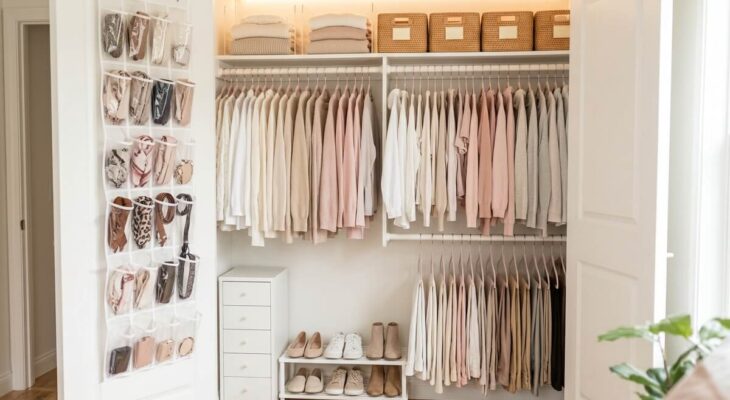
This is one of the simplest and most satisfying upgrades you can make. Bulky plastic and wire hangers waste a surprising amount of rod space, and mismatched shapes make your closet look cluttered even when it’s tidy. Slim velvet hangers take up roughly half the width of standard plastic ones, which can free up several inches across a single rod.
Velvet also grips fabric, so silky blouses and wide-neck tops stay put instead of sliding to the floor. Choosing one color, such as soft blush, ivory, or classic black, instantly gives your closet a cohesive, boutique-like feel. It’s a small change that makes the whole space look intentional and calm.
Add a Second Hanging Rod
Most closets have a single rod placed at a height that leaves a lot of empty air below your shirts and blouses. A double-hang closet rod solves this by hooking onto your existing rod and creating a second level underneath. Suddenly you have twice the hanging space for shorter items like tops, folded pants, and skirts.
Keep longer pieces such as dresses, coats, and jumpsuits on one end of the closet where the upper rod hangs freely, and use the double-hang section for everything shorter. Adjustable versions are inexpensive, require no tools, and can be removed when you move, which makes them perfect for renters.
Use the Back of the Door
The back of your closet door is prime real estate that most people completely ignore. An over-the-door organizer with clear pockets is ideal for shoes, belts, scarves, clutches, tights, or even small beauty items. Because you can see everything at a glance, you’ll actually use the accessories you own instead of forgetting them.
If you prefer a more polished look, try an over-the-door hook rack for your next-day outfit, a robe, or your go-to handbags. A slim door-mounted mirror is another great option if your room lacks a full-length mirror, since it saves wall space while adding function.
Go Vertical With Shelves Above the Rod
The space between the top of your hanging rod and the ceiling is often left empty or stuffed with random items. Adding a second shelf above the existing one, or using stackable shelf dividers, turns that dead zone into organized storage. Shelf dividers are especially useful for keeping stacks of sweaters, jeans, or handbags upright and neat instead of toppling into each other.
Since these upper shelves are harder to reach, reserve them for items you don’t need every day, such as off-season clothing, special-occasion bags, extra bedding, or travel accessories. Keep a small folding step stool nearby so grabbing them never feels like a chore.
Invest in Matching Bins and Baskets
Open shelves can look messy fast, but uniform bins and baskets hide visual clutter and keep small items contained. Woven baskets add warmth and texture, fabric bins feel soft and cozy, and clear acrylic boxes make it easy to see what’s inside. Whatever style you choose, sticking with one or two coordinating designs creates a calm, pulled-together look.
Label each bin clearly with what it holds, such as “Workout Clothes,” “Swimwear,” or “Winter Accessories.” Labels might seem fussy, but they keep the system working long-term, especially when you’re getting dressed in a hurry or sharing the closet with a partner.
Fold Smarter With the File-Folding Method
Instead of stacking folded clothes on top of each other, try file folding, which means folding items into small rectangles and standing them upright in a drawer or bin like files in a cabinet. This lets you see every single piece at once, so you’re not digging through a pile and wrecking it to find one T-shirt.
File folding works especially well for T-shirts, leggings, pajamas, workout clothes, and underwear. It also tends to fit more items into the same space than traditional stacking, which is exactly what a tiny closet needs.
Bring In a Slim Dresser or Drawer Unit
If your closet has some floor space beneath the hanging clothes, a narrow dresser or a set of stackable plastic drawers can double your storage instantly. Folded items like jeans, sweaters, and loungewear can live in the drawers, freeing up rod space for pieces that truly need to hang.
Measure carefully before you shop, including the depth and the height under your lowest hanging item. Rolling drawer carts are a smart choice because you can pull them out to reach things and push them back in when you’re done.
Create a Smart Shoe Solution
Shoes piled on the closet floor are one of the biggest sources of clutter. A slim, tiered shoe rack keeps pairs visible and off the ground, while stackable shoe boxes with clear fronts protect special pairs and make them easy to identify. If floor space is very limited, try storing shoes in the over-the-door organizer or on a narrow vertical rack in a corner.
Rotate your shoes by season as well. Sandals don’t need to be front and center in winter, and heavy boots can be tucked away in summer. Storing off-season pairs under the bed or on a high shelf leaves room for what you wear right now.
Hang Accessories Where You Can See Them
Belts, scarves, ties, and necklaces easily become a tangled mess when tossed into a drawer. Multi-loop hangers and scarf rings let you hang several accessories in the space of one regular hanger. Adhesive hooks on the inside walls of the closet are perfect for belts, hats, and bags.
For jewelry, consider a hanging jewelry organizer with clear pockets or a small wall-mounted panel inside the closet. Seeing your accessories laid out makes it much easier to finish an outfit, and it protects delicate pieces from knots and scratches.
Use Cascading Hangers for Outfits and Pants
Cascading or tiered hangers let several items hang vertically from a single hook, which saves a lot of horizontal rod space. They’re especially useful for pants, skirts, and leggings. Some designs hold five or more pieces in the footprint of one regular hanger.
You can also use cascading hangers to plan full outfits for the week. Hang a top, bottom, and accessory together on one tiered hanger for each day, and your mornings will feel noticeably calmer.
Rotate Your Wardrobe by Season
One of the most effective tiny closet organization ideas isn’t about storage at all. It’s about keeping only the current season in your closet. Heavy coats, chunky knits, and winter boots take up a huge amount of space, and you don’t need them in July. The same goes for linen dresses and swimsuits in January.
Store off-season clothing in vacuum-seal bags, under-bed storage boxes, or labeled bins on a high shelf. When the seasons change, make the swap a little ritual. It’s also the perfect time to do a quick edit and let go of anything you didn’t wear.
Organize by Category and Color
Once everything has a place, arrange your hanging clothes by category first, such as tops, blouses, pants, skirts, dresses, and jackets, and then by color within each category. This simple system makes it easy to find exactly what you need and helps you spot gaps or duplicates in your wardrobe.
A light-to-dark color flow is also beautiful to look at. Opening a closet that looks like a soft gradient feels calm and inviting, and that sense of order makes you more likely to keep it tidy.
Add Lighting to Brighten the Space
Small closets are often dark, which makes them feel even more cramped and makes it hard to tell navy from black. Battery-operated, motion-sensor LED lights are easy to install with adhesive strips and turn on automatically when you open the door. Puck lights under shelves or a strip light along the top of the closet can completely transform the space.
Good lighting doesn’t just help you see. It makes your closet feel more spacious, more luxurious, and more like a little boutique you enjoy stepping into.
Make It Pretty With Small Touches
A closet you love is a closet you’ll want to keep organized. Consider lining shelves with patterned contact paper, adding peel-and-stick wallpaper to the back wall, or placing a small sachet of lavender for a fresh scent. A tiny framed print, a pretty tray for your daily jewelry, or a soft rug on the floor can make the space feel personal and special.
These details might seem small, but they shift your closet from a cramped storage spot into a part of your home that feels thoughtful and cared for.
Keep It Organized With Simple Habits
The best system in the world won’t last without a few easy habits. Try a one-in, one-out rule, where every new piece you bring home replaces an item you donate. Put clothes away right after laundry instead of letting them pile up on a chair. Spend five minutes each week resetting anything that has drifted out of place.
Every few months, do a quick check-in edit. Pull out anything that no longer fits your style or your life, and enjoy the extra breathing room it creates.
Quick Tiny Closet Organization Checklist
| Idea | Space Saved | Best For | Budget |
|---|---|---|---|
| Slim velvet hangers | Up to 50% more rod space | All hanging clothes | Low |
| Double-hang rod | Doubles hanging space | Tops, skirts, folded pants | Low |
| Over-the-door organizer | Frees floor and shelf space | Shoes, accessories, beauty items | Low |
| Shelf dividers and extra shelves | Uses vertical space | Sweaters, bags, off-season items | Low to medium |
| Matching bins and baskets | Contains small items | Workout clothes, swimwear, accessories | Low to medium |
| Slim dresser or rolling drawers | Adds folded storage | Jeans, loungewear, underwear | Medium |
| Cascading hangers | Saves horizontal rod space | Pants, skirts, weekly outfits | Low |
| Seasonal rotation | Frees large amounts of space | Coats, knits, boots, summer pieces | Low |
| LED closet lighting | Makes space feel larger | Dark or deep closets | Low |
Final Thoughts
A tiny closet doesn’t have to hold you back from a wardrobe you love. By editing honestly, using vertical space, choosing slim and matching storage, and building a few simple habits, you can turn even the smallest closet into an organized, peaceful space that makes getting dressed something you look forward to. Start with one or two ideas this weekend, maybe the hanger swap and a double rod, and build from there. Small changes add up quickly, and before long, your little closet will feel like it’s working for you instead of against you.