
Exercises | Benefits | Prevention
A bunion, also called hallux valgus, is a bony bump that forms at the base of your big toe, causing it to point inwards towards the other toes. Bunions are a very common feet problem affecting lots of people. 26% of people between 18 and 65 suffer from bunions while for those above 65 years, 36% are affected.
Bunions are known to be hereditary, but other factors such as wearing constrictive shoes and lack of proper feet or toe exercises contribute to bunions. Bunions can lead to other problems such as calluses because as you walk, bunions carry the exerted pressure instead of the ball near your big toe.
This causes your bunions to become very painful as you put pressure on them. It can also lead to the development of calluses. Bunions cause a lot of discomfort and pain, which can be relieved either using medication, surgery or through exercises.
We’ll focus on simple exercises that you can carry out at home to relieve your bunions and prevent them from developing further.
Here are 14 Simple Yet Effective Exercises for Bunions
1. Toe Stretches
Toe stretches help elongate and strengthen the muscles along the arch, heel, and underside of your foot, improving flexibility and joint alignment.
How to Perform:
-
Starting Position: Sit upright in a comfortable chair with both feet flat on the floor.
-
Setup: Lift one foot and rest it across the opposite thigh.
-
Execution: Secure your foot near the ankle with one hand to keep it steady. With your other hand, gently grasp your toes and pull them toward your shin until you feel a gentle stretch. Pull only as far as comfortable without causing pain.
-
Hold: Maintain the stretch for 15–30 seconds, then release. Repeat 2–3 times per foot.
Benefits:
-
Targeted Muscles: Stretches the muscles, tendons, and fascia along the arch and heel.
-
Foot Health: Strengthens the supportive muscles underneath the toes, supports big toe joint mobility, and helps prevent secondary conditions like plantar fasciitis.
Pro Tip for Bunion Care: Combine toe stretches with Toe Splays (spreading your toes apart wide) or Marble Pickups using your toes to further build intrinsic foot strength and stability.

2. Big Toe Stretch & Mobility Mobilization
This multi-directional stretch helps gently realign the big toe joint while loosening tight surrounding connective tissues.
How to Perform:
-
Starting Position: Sit comfortably in a chair with one foot resting across the opposite thigh.
-
Setup: Hold the base of your foot steady with one hand to isolate the movement. With your other hand, gently grasp your big toe.
-
Alignment Stretch: Gently pull and align your big toe outward into its natural, straight position (away from the second toe). Hold this aligned position for 10 seconds.
-
Multi-Directional Mobilization: Slowly stretch the toe through its full range of motion:
-
Flex it upward toward your shin.
-
Flex it downward toward the sole of your foot.
-
Gently move it side-to-side.
-
-
Repetitions: Repeat the entire sequence 3 times, then switch to the other foot.
Benefits:
-
Joint Realignment: Reduces medial pulling forces on the big toe joint to encourage proper posture.
-
Mobility & Flexibility: Relieves stiffness in the first MTP joint, making walking and weight-bearing more comfortable.
-
Pain Relief: Eases tension in the surrounding ligaments and soft tissues affected by bunion friction.
Pro Tip for Safety: Never force the joint or stretch into sharp pain. Apply gentle, smooth pressure—you should feel a firm stretch, not discomfort. For best results, perform this exercise after a warm foot bath or light activity when tissues are warm and pliable.

3. Toe Spreads
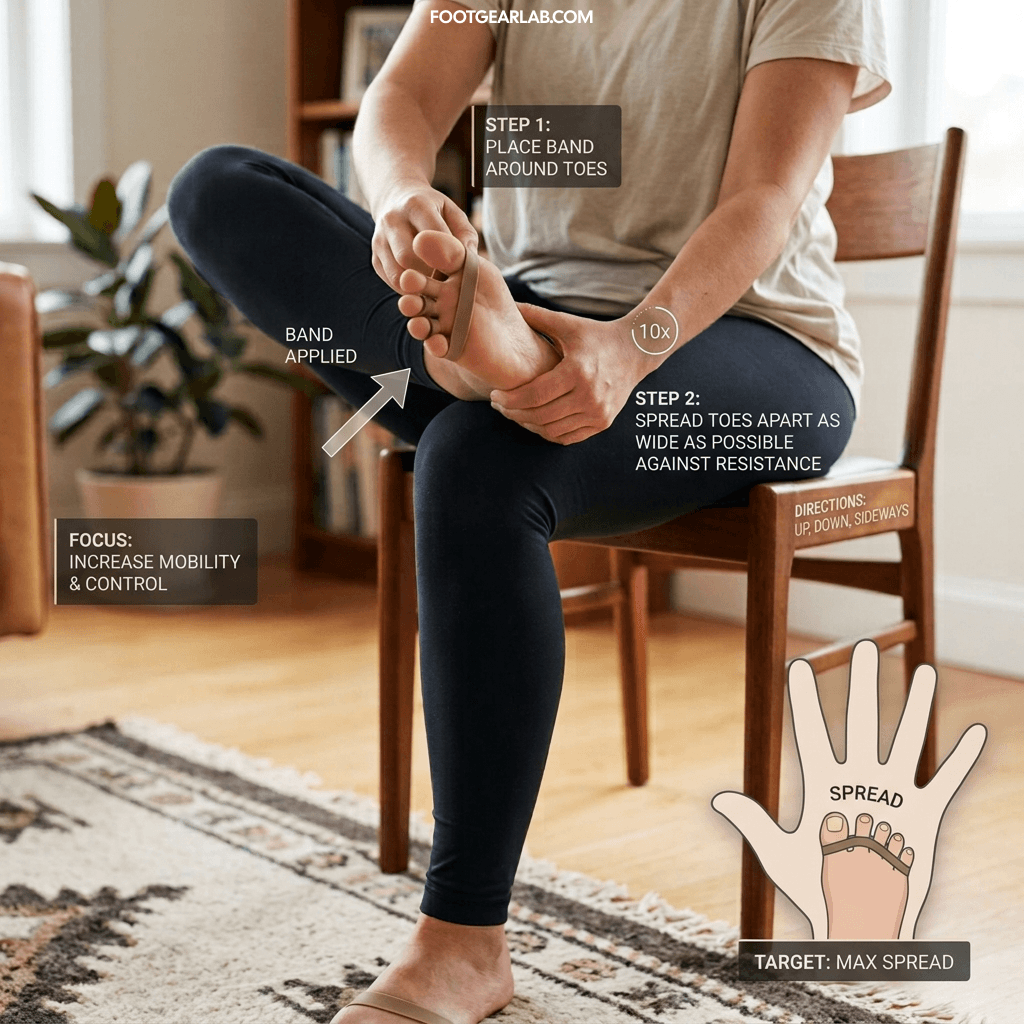
This exercise encourages independent movement of the toes and strengthens the muscles responsible for stabilizing the forefoot.
How to Perform:
-
Starting Position: Sit upright in a comfortable chair with both feet resting flat on the floor.
-
Execution: Actively spread all your toes as wide apart as possible without causing any strain or discomfort.
-
Hold: Maintain the wide position for 5 seconds.
-
Repetitions: Complete 10 repetitions.
-
Adding Resistance (Optional): To further challenge the muscles, loop a light exercise band or rubber band snugly around all five toes. Spread your toes apart against the resistance of the band.
-
Bilateral Options: You can perform this exercise on both feet simultaneously or alternate one foot at a time, depending on what feels most comfortable.
Benefits:
-
Mobility & Control: Increases joint flexibility and neuromuscular control of the small toe muscles.
-
Bunion Support: Strengthens the abductor muscles, which helps counteract the inward pull of a bunion on the big toe.
-
Foot Fatigue Relief: Helps release tension across the forefoot after a long day of wearing restrictive footwear.
Pro Tip for Progressions: Start without resistance to master the movement before adding a rubber band. Ensure the band has light tension so it doesn’t pinch your skin or restrict healthy circulation.
4. Big Toe Circles
This gentle mobilization exercise rotates the big toe through its full circumference to improve joint mobility and reduce stiffness.
How to Perform:
-
Starting Position: Sit upright in a comfortable chair with both feet flat on the floor.
-
Setup: Lean forward safely to reach your foot (or rest one foot across the opposite thigh if that is more comfortable).
-
Stabilization: Place one hand securely around the forefoot or arch to keep the rest of your foot still. Grasp your big toe near the base with your other hand.
-
Execution: Gently rotate your big toe in a slow, smooth, circular motion.
-
Repetitions: Complete 20 rotations clockwise, then reverse direction for 20 rotations counter-clockwise.
-
Switch: Repeat the full sequence on the big toe of the opposite foot.
Benefits:
-
Joint Mobility & Fluid Circulation: Stimulates synovial fluid within the big toe joint, reducing friction and stiffness caused by bunion deformity.
-
Flexibility: Gently lengthens tight surrounding tendons, ligaments, and capsule tissues around the MTP joint.
-
Pain & Tension Relief: Eases joint pressure after standing or walking in close-fitting shoes.
Pro Tip for Comfort: Focus on small, smooth circles rather than large, forced movements. The goal is gentle mobilization, so always stay within a comfortable, pain-free range of motion.

Want a Way to Track If These Are Working?
The Bunion Relief Toolkit includes a printable tracker to log which exercises you try
and how your pain responds — plus 13 more non-surgical methods like footwear fixes,
orthotics, and home remedies to pair with your routine.
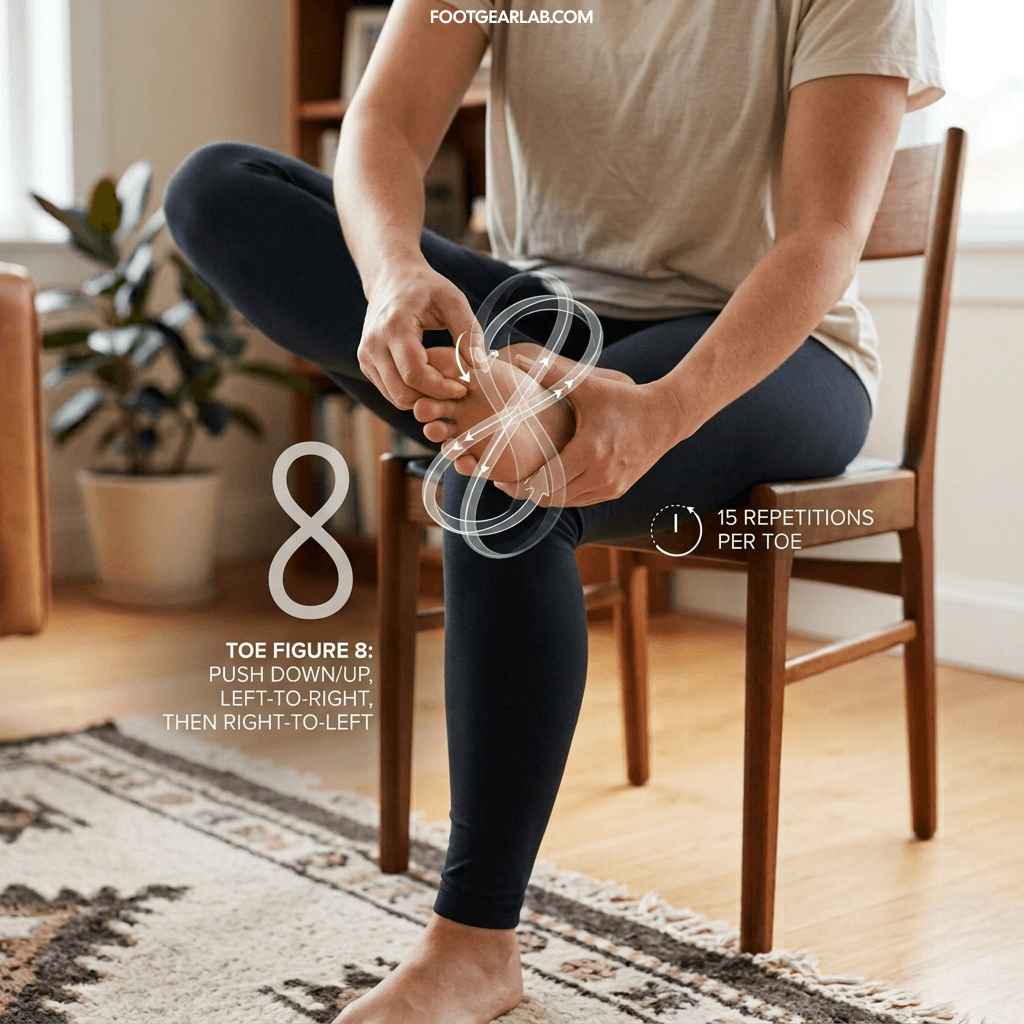
5. Figure-8 Toe Rotations
This dynamic mobilization exercise combines flexion, extension, and lateral movement to gently guide the big toe joint through its full functional range.
How to Perform:
-
Starting Position: Sit upright in a comfortable chair with your feet flat on the floor (or cross one foot over the opposite thigh for easier reach).
-
Stabilization: Hold the base of your foot or forefoot securely with one hand to keep it still. With your other hand, gently grasp your big toe.
-
Execution: Move your big toe in a continuous figure-8 pattern:
-
Smoothly guide the toe down and up while sweeping from left to right.
-
Without pausing, sweep the toe down and up while tracing back from right to left to return to the start.
-
-
Repetitions: Complete 15 full figure-8 rotations on one foot.
-
Switch: Repeat the sequence on the big toe of the other foot.
Benefits:
-
Enhanced Joint Tracking: Helps keep the first MTP joint aligned and glides the cartilage smoothly across the joint surface.
-
Multi-Directional Flexibility: Targets tight surrounding tendons and ligaments that static or linear stretches might miss.
-
Neuromuscular Control & Strength: Improves flexibility and coordination of the intrinsic muscles that stabilize the big toe.
Pro Tip for Smooth Movement: Think of drawing an infinity symbol ($\infty$) with the tip of your toe. Keep the movement slow, fluid, and completely pain-free to avoid irritating the joint capsule.